在研究、書寫、策展、社群與公民行動的這幾年,我們持續在理想與現實的縫隙之中摸索:介於文化與政治、情感與行動、全球與在地之間,我們一次次在不安與卡關裡,學習前進。 這場分享,是一次把情感轉成行動的練習。也是我們想為新的一年開啟的第一個場景。 本次將由朱筱琪與吳虹霏一起分享——「從不安中學習,在邊界行走:從關照走向共同行動」。我們會一起聊聊當「關照」不只是看見時,它要怎麼真的變成行動?在言語還未完備、想法還未落地的時候,我們又能怎麼在裂縫裡繼續嘗試?以及,在研究與行動之間,我們如何找到自己的位置,從那些不安、不適的感受裡,重新理解共存、正義與連結。 分享會從知識、身體、到社會三個層面出發,帶大家走過不同田野的現場——我們各自的經驗。從遷徙、記憶到再現、從生態、女性到療癒,最後試圖交織在一起:「我們可以怎麼一起行動?」 這個從最長的黑夜開始的活動將持續一年,希望成為一個能分享困難、也能孕育行動的地方,歡迎對此有共鳴或好奇的你一起練習傾聽、回應、彼此學習與去學習(unlearn)。這個計畫未來也會延伸到我們各自的平台:引用吧、難民路徑(強迫遷徙議題),以及更多跨領域的共學與行動。 《從最長的黑夜開始》系列計劃|2026 年度前導簡介 《從最長的黑夜開始》系列計劃是一個結合研究、行動與公共對話的年度企劃,關注如何在快速變動的世界裡,讓情感轉化成力量,讓知識走向行動,讓關照成為具體可見的公共實踐。面對遷徙、衝突、文化斷裂、情感不安與民主社會的挑戰,我們希望打造一個跨領域、可共享與能行動的公共場域,讓不同背景的人能一起思考、一起嘗試、一起前進。 計劃從三個面向展開:知識(Knowledge)、身體(Embodiment)、社會(Society),透過講座、對談、行動工作坊、田野共學與故事轉譯等形式,討論遷徙與邊界、文化記憶、人權與公民教育、生態智慧、療癒與韌性等主題,強調理解、感受與行動三者之間的轉換與互動。 2026 年,我們將以更開放的方式邀請公眾與實踐者加入,在裂縫中持續實驗,在邊界中尋找連結,讓行動在彼此的陪伴下發生。 分享者:朱筱琪 CHU, Hsiao-Chi 跨領域實踐者,專注於藝術、文化遺產、遷徙、難民與人道發展相關議題。擁有策展、社區藝術計畫、人權倡議及國際 NGO 工作經驗,曾於蒙古、巴勒斯坦、柬埔寨、史瓦帝尼及荷蘭進行田野與專案。為「Refugee Path」與「台灣難民週」創辦人,致力於在台灣推動對強迫遷徙與全球議題的多元參與。目前為荷蘭萊頓大學國際亞洲研究所(IIAS)附屬研究員,以及台灣空間藝術聯盟(TASA)研究員。著有《遊走邊緣的國度:那些被遺忘的流亡行李-巴勒斯坦》(2023)。關注如何將文化實踐與社會正義、流離敘事與永續發展連結起來。 分享者:吳虹霏 WU, Hung Fei 策展人與研究者,自2019年起擔任本事藝術總監。2023年發起探索女性主義環境人文的平台「引用吧」(citing bar),致力透過跨領域與跨文化合作,擴展多樣的知識型態、生態智慧與世界觀,將這些具轉化力的能量傳送至深陷在多重危機與衝突中的星球。2024年起展開munus計畫,深入「當代療癒」的思想與實踐可能,從免疫(immunity)與社群(community)的角度,以及讀書會與集體性的女性方法,探索在滿佈衝突與創傷的世界,共同學習/生產並拓寬關於健康與治癒的種種另類智慧,並試圖實踐「關照作為事件」(care as an event)的非典型展覽製作之可能。2023年起定期撰稿發表於《藝術家雜誌》「生態女性藝術」專欄。
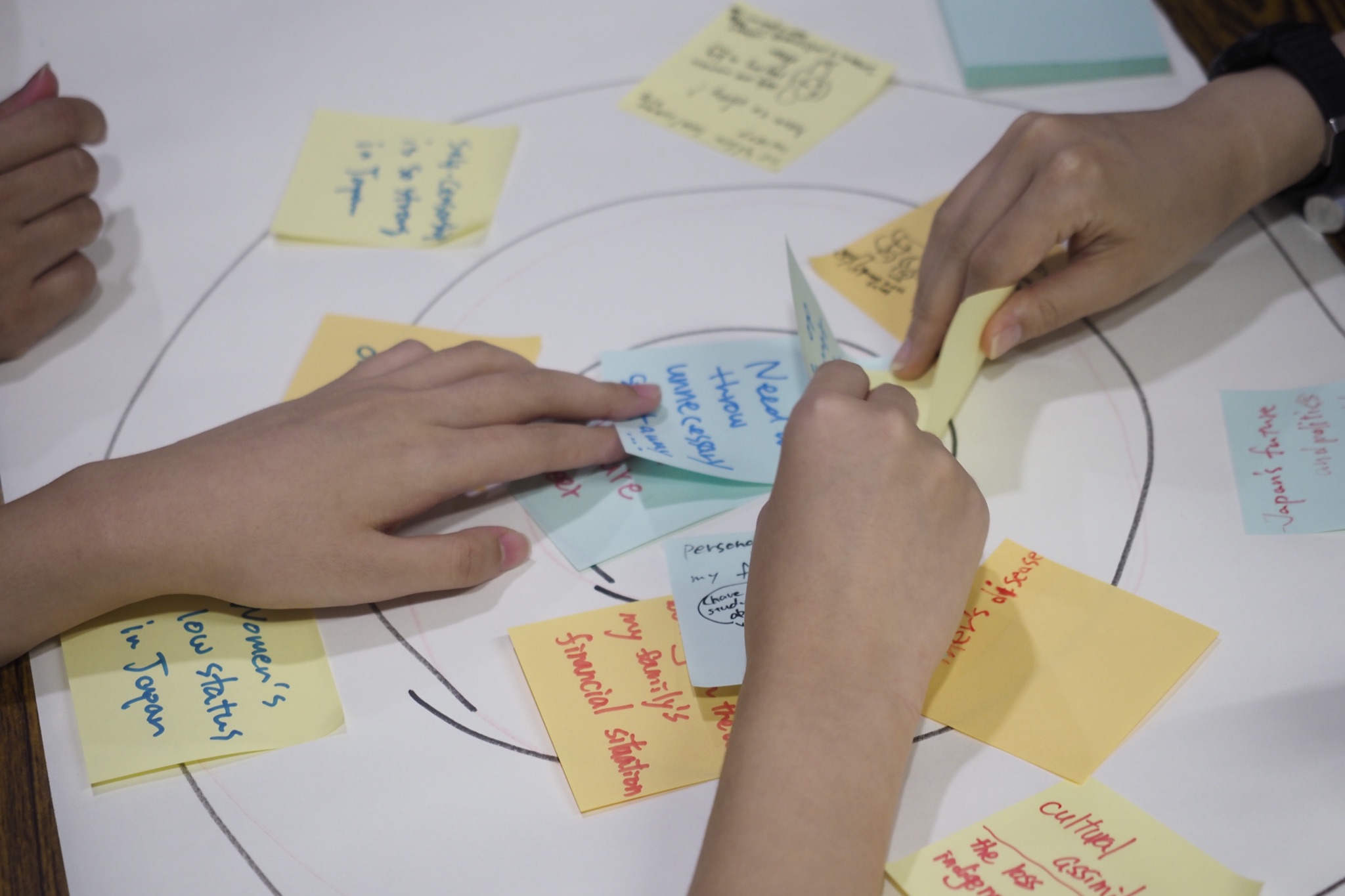
很高興在一年之後,再次延續了與東京藝術大學的對話。這種持續且長期的合作極其珍貴,它不僅是學術上的交流,更是建立跨文化藝術共同體的重要基礎。本次計畫在主題上從去年的個體療癒進一步延伸至更廣闊的社會層面,探討藝術如何介入複雜的歷史與社會議題。相較於去年廣泛認識臺灣藝術生態的「踩點」行程,一週的時程安排更為聚焦,核心鎖定在內部的學術講座、以及兩校學生們分組進行的研究與藝術創作。 黃建宏老師的講座以「yearning」(渴望/鄉愁)為核心,深入探討1970年代臺灣藝術在面對日本殖民與國民政府治理之間,所產生的複雜矛盾鄉愁與其對藝術風格演變的影響。荒木夏實老師則透過倫敦帝國戰爭博物館的策展案例,展現了面對困難歷史時,策劃者對殖民帝國主義心態進行批判性思考的努力,並介紹了幾位關注歷史議題的日本當代藝術家。 我個人負責的兩場工作坊,則以我的研究與展覽計畫「munus」為引。這個拉丁詞彙同時帶有責任/禮物、免疫/社群的雙重或複數意涵。我邀請臺日學生們分組,一同檢視個體日常與集體社會中潛藏的不安與病徵,並探討藝術對這些由現代性交織而成的集體焦慮狀態,有什麼樣的回應與創造空間的可能(與不可能)。 關照一直是貫穿這兩年工作坊的重要主題,在第一場工作坊,在坦露彼此的困境與試圖尋找突破點之時,也成為連結彼此的滲透空間,建立起團結情誼。收尾工作坊則借鑒了藝術家Cassie Thornton所設計的Hologram模型,鼓勵學生練習深度聆聽與實踐關懷。此目的在於卸下傳統的醫療權威與冰冷距離,讓彼此成為支持性的「親密處方」與「活歷史」。這種方法強調了藝術不僅是表達,更是關係建立與生命支持的實踐。 最讓我驚喜與感動的亮點,莫過於學生們在兩天田野調查與創作後的發表。在這個基本價值觀與相互依賴關係搖搖欲墜的時代,我從他們的創作中看見了藝術成為復甦希望的動能:藝術創作在材質與感官層面提供經驗古老故事的未來想像入口,抑或是在文字中取捨、留白,給予另一種想像與敘事的可能;以及透過身體性、非語言的方式,揭示出限制我們展開對話的社會框架,並鼓舞我們練習卸下這些框架,邁向自由。 這些作品對我而言是最好的禮物,那就像是透過學生們乾淨清澈的目光,一針一線細心編織Le Guin所說的提袋(carrying bag),以謙遜、非嘩眾取寵的姿態,試圖承載並理解歷史的複雜傷痛、矛盾與對立,側重於細緻入微的介入,而非急於提供立即的療癒。我衷心祝福在這一段時間的交流與共同創造的關照空間,能夠回過頭來滋養我們在日常中感到失去連結與無能為力的時刻,將情感轉化為行動的真實力量。
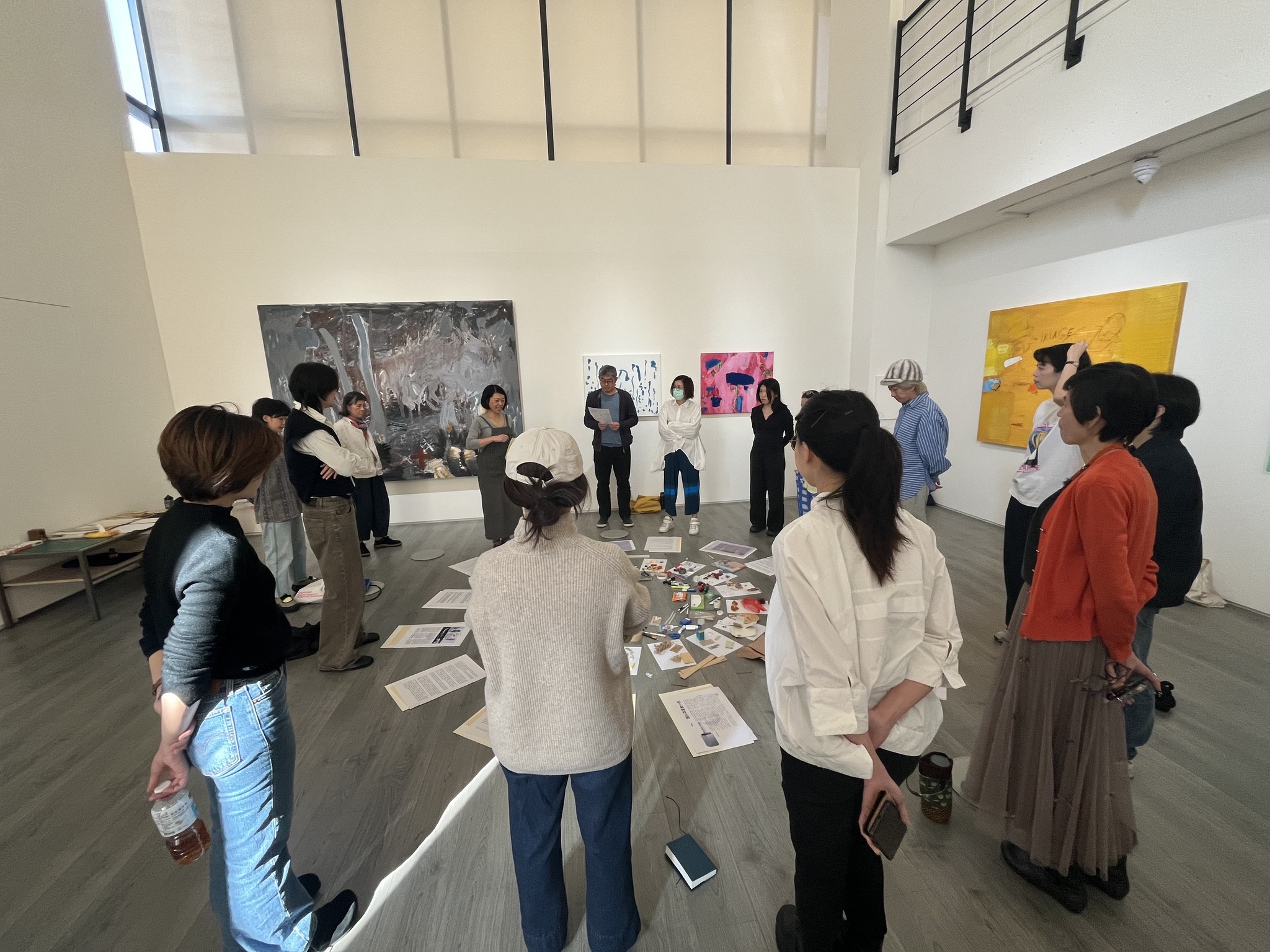
葉竹盛老師為藝術界帶來的不是既定框架式的流派、風格,是允許開放、連結;不是朝向個人英雄式的成就積累,而是透過學院與非學院的教育交流,啟發無數的創作,其中也包含書寫。 這場工作坊由「引用吧」設計,受到Rosi Braidotti的「縱橫後人文學科」(Transversal Posthumanities)概念*,與女性主義環境人文讀書會團體對此概念的延伸創造「縱橫詩學」啟發**,以與葉竹盛老師圍繞在即興、遊戲、不可預期性等概念的未完成討論作為線索,取材展覽中的自述、評論、報導、創意書寫等種種文字,透過撿拾、拼湊、援引歷史書寫的交織過程中,試圖讓集體性的創造在當下顯現,進而期盼能對葉竹盛的創作與世界觀提出更開闊更積極的回應,讓對話與探索繼續。 正如生命的源頭與待發生的機遇、正如如此不同的每個個體與每個字句,永遠是相互依賴與關聯。當我們面對秩序與非秩序、已知與未知、親密與陌生之間的半透明模糊地帶,那將是詩與真正的「當下」發生之處。 * 縱橫的政治概念(Transversal Politics)原本由關注交織性與歸屬政治的學者妮拉.尤瓦爾.戴維斯(Nira Yuval Davis)提出,以做為對同化政治的替代取徑,後由羅希.布拉伊多蒂(Rosi Braidotti)提出「縱橫後人文學科」(Transversal Posthumanities),以新物質理論框架辨認出後人文中的利益導向、認知資本主義的知識生產,從而導向社群驅動的、非利益導向的少數知識。 ** 在詹姆斯.嘉蒂納(James Gardiner)、海莉.辛格(Hayley Singer)、珍妮佛.漢彌頓(Jennifer Hamilton)、奈伊瑪尼斯與敏迪.布萊斯(Mindy Blaise)合著的文章〈讀書會做為女性主義環境人文的方法〉(Reading Group as Method for Feminist Environmental Humanities)中,他們對「縱橫」的應用是,在參與者回饋的文字篇幅中隨機畫一條線,再將這條線經過的字詞以短詩串起來,「將看似不相關的事物拉在一起、創造新的連結」。儘管截線是武斷的,但也是這樣的武斷幫助超越已知、照亮邊緣的或不愛、不願指認的張力。 工作坊帶領:蔡宛璇 澎湖成長,旅法數年,後定居台北地區。創作媒介從裝置、圖像、錄像和詩文著手,她的裝置作品經常具暫時性,並與所存在空間構成一特殊關係。而她的錄像創作受實驗電影啓發,呈現開放性的敘事空間,或將風景轉變為內在活動的的折射。2004年起與聲音藝術工作者 Yannick Dauby 合作「拾景人」系列創作計劃,陸續於國內外駐村,透過展覽、出版、錄像或小型演出等形式發表的駐地影音創作,自此逐步探索創作空間的多元可能。2018年兩人創立「回看工作室」。著有個人詩文詩集「潮汐」、「陌生的持有」、活版印刷有聲親子詩集「我想欲踮海內面醒過來」、詩圖集「感官編織」。 工作坊策劃:吳虹霏 策展人與研究者,現居台灣台北。長年關注生態議題,近年則結合個人生命經驗與女性主義的視角,投入於女性主義環境人文的研究中,2023年發起探索女性主義環境人文的平台「引用吧」(citing bar),以「引用」的中文諧音「飲用」作為滋養個體肉身與對周遭環境的關照連結,也援引「引用的政治」(Politics of...
One of the core issues of contemporary art is how it connects with real society. In recent years, there has been a growing interest in how art contributes to well-being, such as promoting mental health. This project, initiated by Tokyo University of the Arts and curators Natsumi Araki and Min Nishihara, invites “citing bar” to collaborate with Solid Art in a workshop format to explore the relationship between art, caring, and healing. Inspired by the pandemic and numerous environmental and geopolitical crises, I have delved into feminist environmental humanities. In 2022, I curated Tides in the Body, a project that connected internal chaos and external crises through water, probing how acknowledging both sources and dilemmas can empower one another, breaking boundaries to form a collective resilience through language and action. The exhibition touched upon the “politics of citation,” which further inspired the creation of citing bar. Starting in 2023, this initiative has fostered cross-disciplinary and cross-cultural collaborations, offering exhibitions, discussions, screenings, writing, reports, and publications to expand various knowledge forms, ecological wisdom, and worldviews, with the hope of practicing care and justice in a world beset by crises and conflicts. Last year, during a field research trip on ecofeminism in Asia, I was deeply impressed by the sensitivity I observed in exhibitions and artists I visited in Japan. Beneath this seemingly calm society lies unlit spaces of oppression, and these gaps are where creativity springs. I felt the same social sensitivity and empathy from the presentation by the students on the first day, prompting me to ponder what kind of era and world we inhabit and how art can help us find our voice—not just to define our place but to create a collective space for holding the as-yet unvoiced cries for justice and the wounds still awaiting warmth. The two-day workshop led by Min provided profound inspiration for creating such spaces. While reading the script that had been pre-collected, arranged, and translated, I was struck by the unreserved honesty of those “unspeakable” experiences. These words held tremendous power, built on trust and sharing. When we offer a story, we create a space where resonance can happen. Most do not realize that by simply doing so, a possibility for healing begins. These spaces gain further vitality through each other’s voices, blending in shared time and space. Boundaries dissolve, creating an expansive, resilient space filled with collective mourning and blessings. In the workshop I led the next day, on a sunny morning, we began with a meditation and a ritual of drinking, then attuned our senses to the environment and to each other. The exercise of “citation” led us to create an inspiring list of listens/reads/reflections, including four musicians, four artists, a writer, two former classmates, and one grandmother. The most challenging practice was recreating the ancient Greek healing temple Asklepieion. It was my first time guiding this exercise, but with the foundation of trust built in Min’s workshop, everything unfolded smoothly. In the final offering session, each group shared creative daily healing prescriptions from their experiences. This resonant experience nourished me to continue exploring how to define “we” in a world of constant conflict and oppression and to understand what care and sustaining wisdom are needed to heal our future. I heard that everyone later got caught in a downpour in Jiufen. I hope that rain made our shared memories of self-healing and connection even more vivid. I will always keep close the invaluable insight gained from reading those intimate experiences—that maybe voicing ourselves doesn’t always require sounds— like in Mutant Message Down Under, the indigenous Australian tribes were said to be able to communicate across time and space, and I believe art can be a way of voicing, helping us realize and expand spaces that resist oppression and are free, joyful, and full of love.
“Citing Bar” is a platform exploring feminist environmental humanities. As a Mandarin homophone for “drinking”, the title “citing” also acts as a ritual of nurturing both the body and the holistic connection to nature. Additionally it pays homage to the evolving concept of the “politics of citation” aligning the core spirit of the project, that is, to acknowledge origins, borders and ordeals, thereby fostering a sense of solidarity for the purpose of enabling the prosperity of land, the environment, human and more-than-human alike. While stimulating cross-disciplinary and cross-cultural collaborations, “Citing Bar” aims to broaden the spectrum of knowledge, ecological wisdom and worldviews, channeling transformative energy into this planet that is bombarded by multiple crises and conflicts. In addition to exhibition spaces, the venue featured a library for reading and a tea-drinking section for relaxation; meanwhile, participatory events including talks, screenings, writing, reportage and publications were organized to continually raise awareness about care and justice. In 2023, “Citing Bar” featured four sub-projects at Solid Art in Taipei, Taiwan, all revolving around the closely intertwined concepts of rest, healing, immigration, crip ecologies and climate justice. This publication serves as a summary of the various explorations and learnings throughout the four seasons of the year. Presented in the form of a newspaper to facilitate the flow of information, it also crystallizes as an invitation and an end-of-year blessing to the world. In this event, Anna-Kaisa Koski, co-founder of PUNOS, one of Citing Bar’s partners, will also share their collaborative art practices on climate and ecology. 💧 Special Guest: Anna-Kaisa Koski, co-founder of Punos (FI) Punos Arts & Research is a Helsinki-based collective founded by curator-researchers Anna-Kaisa Koski and Ki Nurmenniemi in 2020. Punos acts in the area that lies between the worlds of academic research and the arts: weaving, translating and transmitting ideas and discussions that lead towards more just and socio-ecologically sustainable worlds. Punos collective seeks to drive social change within the cultural sector through art, research, and training. For just sustainability transformations to thoroughly permeate societies, new ideas, stories and leaps of imagination will be needed. Hence the meaningful processing and understanding of climate change, loss of biodiversity and other ecological threats will require cultural research approaches and creative methods. Punos works in close cooperation with artists and our interest lies in the importance of imagination in building livable, loveable, and sustainable futures. Our collaboration with curator Hung-Fei Wu and the Citing Bar programme has started out from shared interest in whose voices are heard, encouraged, circulated, and cited in discussions where the climate and ecological crises and responses to them are being negotiated.
Developed by “The Weathering Collective,” “A Field Guide for Weathering: Embodied Tactics for Collectives of Two or More Humans” was co-written by Jennifer Mae Hamilton and Astrida Neimanis. WU Ren-Yu and Hsu Shih-Yu introduced the guide to the Chinese audience and hosted workshops in various locations, including markets in Taichung, Taipei Dangdai Art & Ideas, the intertidal zone in Kinmen, and the Children’s Museum of Arts in Taoyuan. They practiced the experience of weathering with diverse participants. The format presented at Solid Art in Taipei was adapted from the versions mentioned above. “Ten million years ago, the island of Luzon in the Philippines began moving northwestward until it collided with the southeastern part of the Eurasian continental plate. This collision led to the emergence of Taiwan Island and the formation of mountain ranges on it, a process known as the Penglai Orogeny. The terrain of Taiwan Island rose as its crust folded and deformed, and its land underwent erosion and accumulation through the movements of rivers. This geological activity resulted in the formation of the alluvial plain in the west that we find today. … Three million years ago, the Luzon volcanic island in the core of the Eastern Coast Mountains gradually merged with the Central Mountains, forming the East Longitudinal Valley, which became the suture of the two major plates. As the Philippine Sea Plate moved northwestward and subducted under northern Taiwan Island near the Ryukyu Islands, the Ryukyu Island was formed. Since 2.8 million years ago, it has intermittently been located in Datun Mountain, Keelung Island, and Mianhua Island in Taiwan. Large-scale volcanic eruptions occurred in offshore areas and continued until 200,000 years ago.” (Mei-Chuan Huang, 2018) Imagine where we are—amidst the magma accumulation resulting from 2.8 million years of mantle extrusion and volcanic eruptions. Both in terms of time and space, we find ourselves near the Taipei Lagoon and Guandu Wetland. As we withdraw inward, we encounter the Tamsui River, Zhonggang Creek, Keelung River, and the Tidal Barrier. Returning to this modern building situated by the river, resting on the cooled lava of an ancient volcanic mountain, you share the space with numerous individuals. The modern infrastructure within these buildings ensures comfortable conditions in terms of temperature, humidity, lighting, and hygiene. Do you happen to know the route to the nearest mountaintop? And, have you considered the duration it takes to walk to the nearest river?
<EarthSea Talk+Screening> is a curatorial collective project in which curators active in each city select a topic and discuss it together, and select an artist who fits the topic to create a screening. The screening is simultaneously screened in each city and adopts ‘moving image’ as the main medium as the concept of traveling.
Five women curators from each city who have similar concerns under the themes of ‘eco-feminism’ and ‘explore capitalism’ jointly conduct research. Based on research and discussion, the curator selects an artist suitable for the subject, and the moving images of the selected five artists are screened as one screening. The screening is a concept that tours the city starting with the SFAC Galleries, LOOP and continues to Citing Bar and Solid Art.
<EarthSea Talk+Screening> is a curatorial solidarity to share the current situation in which the imagination of artists and the dynamics of activists, who have been exploring ecological issues, encounter and politicize in various ways. (The screening and talk event at Citing Bar will be conducted in English)
For the next stage of “Citing Bar”, we will be looking at the intersectional ideas of climate justice and we wish to expand multiple forms of knowledge, ecological wisdom and worldviews through cross-disciplinary and cross-cultural collaborations. Participatory activities, including translating, research, writing, reporting and publishing will be organised to sustain awareness of care and justice. Yu-Chen Wang has a long-standing interest in exploring the relationship between technological development, human progress, and the complexity of human impacts on the environment. Over the past two years, she has created a series of works in response to the history of coal mining in the UK and the use of peatlands for agriculture and fuel; the subsequent effects of excess carbon emissions, resource depletion and biodiversity loss. This summer, the artist is undertaking field research along the west coast of Taiwan and investigating the historical context of hydrological landscapes. Focusing on the estuaries of the Tamsui River, the Zhuoshui River and the Zengwen River, she is exploring how highly diverse mangrove ecosystems are coping with human development that threatens their habitats; how they contribute to sequestering carbon in wetlands and mitigating climate change that are urgent global concerns we are facing today. The new findings will serve as source material for “the Citing Bar” climate collaboration project in the future. For this informal event, the artist will share sketches, images, archives and interviews gathered so far. She will be in conversation with curator Hung-Fei Wu, and invite everyone to join the discussion and enjoy specially created mangrove ecosystem-inspired drinks. *Special thanks to Professor Sheue, Chiou-Rong and Professor Lin, Hsing-Juh, both from the Department of Life Sciences at the National Chung Hsing University. About Artist Yu-Chen Wang The work of Yu-Chen Wang asks fundamental questions about human identity at a key point in history, where ecosystems and technosystems have become inextricably intertwined. Her projects mostly have been created through undertaking residencies, developing cross-cultural/disciplinary collaborations and delivering site-responsive commissions. Exhibitions at museums and galleries include Le lieu unique (Nantes, 2022), Drawing Room (London, 2021), MoCA Taipei and theCube (2020), Kumu Art Museum (Tallinn, 2020), National Taiwan Museum of Fine Arts (Taichung, 2020), Science Gallery Dublin (2020), iMAL (Brussels, 2020), Science Gallery London (2019), CCCB (Barcelona, 2019), Tbilisi Triennial (2018), FACT (Liverpool, 2017), CFCCA (Manchester, 2016), Taipei Fine Arts Museum (2016), Manchester Art Gallery (2016), Yeo Workshop (Singapore, 2015) and Taipei Biennial (2014); residencies at Taipei Artist Village (2019), Seoul Museum of Art (2017), Science and Industry Museum (Manchester, 2015). She received the Honorary Mention Collide International Award, Arts at CERN (Geneva, 2018).
“I have a vision, which I call ‘Neuro-Emergence’: to liberate oneself and those on the margins from the neurons onward, creating a new humane language and philosophy. This language and philosophy must be realized through the bodies they seek to liberate. This is where my dance and performance art project resides – in the space where the permanence of words, the fleetingness of actions, and the boundaries of our identities intersect. The ultimate goal is aesthetics: despite the frail darkness of the brain, to create a desire that starts from our neurons, longing to experience life within our bodies.” – Li-Ya Yu “For the families of disabled individuals, their existence lies in providing value to the lives of their loved ones. For the sake of those they love, families will take care of themselves to continue caring for these individuals. The right to life for disabled individuals has nothing to do with societal contributions and burdens. We should not use unequal values to determine who deserves to live.” – Yu-Yin Liao Quoting from the September #neuro-emergence workshop, we invited neuroscientist and sociologist Li-Ya Yu to give a short talk. You can listen to her recent explosive performance with Han Cheung’s newly formed heavy metal band neuropathik; you can also have conversations with caregivers for people with physical and mental disabilities and dementia. This is a space for coexistence, including anxiety and struggles, and hopes to accommodate a variety of bodies in precarious situations. If the human body has more than sixty trillion cells, among them, the nerve cells that intertwine between the skin, muscles, fascia, carrying out sensory and motor transmission, and even forming memory loops… who knows how many there are. You can look it up on Wikipedia, the human brain consists of about 86 billion neurons. However, how these cells “live” in our bodies and lives, governed by what kind of intertwined discrimination, drugs, and societal concepts. How do we face and guide the loops of depression, and then unite and transform them into a force to break down discrimination? Looking at it from a more diverse perspective, if it’s a bucket of compost, a pile of fertile soil, how many bacteria and organisms are communicating inside, and how do we stir it in a timely manner to decompose and reassemble nutrients, forming relationships that herbicides and fertilizers cannot achieve? “Im Schatten meiner Schädelhöhle ist Leben… In the shadow of my skull cavity is life… In the shadow of my skull cavity is life…”
To continue the project “Zoë” in Taiwan, artist Ting-Ting Cheng invited immigrants based here to recite extracts from the interviews of the performers she worked with in Paris. “Zoë” includes a dual-channelled video installation and a publication revisiting the book “Last Words from Montmartre” by Qiu MiaoJin, a self-identified lesbian Taiwanese writer based in Paris between 1992 and 1995. The book was comprised of letters written by Qiu a week before her suicide at age 26 in her room in Montmartre, Paris. During Cheng’s artist residency in Paris, Cheng invited female immigrants in Paris to read the letters extracted from the book in their mother languages at locations where Zoë, the protagonist of the book, visited. As a continuation, the interviews with the performers in Taiwan were also documented. These stories about female immigrants around the world will continue to be written and read, perpetuated through the act of citation – the Speech Act of vocalising words. This project aspires to evoke and connect within the realm of departed lives, to reestablish relationships within seemingly isolated individual circumstances. *The project and the exhibition are supported by the Ministry of Culture, Taiwan.
The next phase of ‘Citing Bar’ will look at the intersecting idea of climate justice, wishing to expand multiple forms of knowledge, ecological wisdom and worldviews while stimulating cross-disciplinary and cross-cultural collaboration. Participatory events including translation, research, writing, reportage and publication will be organised to raise sustained awareness of care and justice. In this precursory event, curator and researcher Yasmine Ostendorf-Rodríguez will be sharing her new book ‘Let’s Become Fungal!’ includes mycelial meditation, book reading, questions raising and idea exchanging. About ‘Let’s Become Fungal!’ There is a growing interest in fungi and mycelium as a material, the ever-branching connecting threads of the fungal world. The entanglements and how this rhizomatic network functions is not just a fascinating ecological system and material, but carries a profound usefulness as a metaphor for our potential new systems, ways of thinking and behaviors. Let’s Become Fungal! takes its inspiration from the world of art and mycology and shares innovative practices from Latin America and the Caribbean that are rooted in multispecies collaboration, symbiosis, alliances, non-monetary resource exchange, decentralization, bottom-up methods and mutual dependency—all in line with the behavior of the mycelium. Every chapter is phrased as a question. They do not lead to answers, but to twelve teachings addressing for instance collaboration, decoloniality, non-linearity, toxicity, mobilization, biomimicry, death, and being non-binary. Simultaneously it ventures deeper into the world of fungi. The teachings from the fungus may inspire artists, collectives, organizations, educators, policy-makers, designers, scientists, anthropologists, change-makers, curators, urbanists, activists, gardeners, community-leaders, farmers, and many others, to become more fungal in their ways of working and being. Let’s Become Fungal! is more than a book. It’s a methodology and a way of thinking that can be activated in communities, networks, and organizations. The author offers a program of twelve collaboratively crafted mycelial workshops to activate each Teaching with a group. From mycelial meditations to Reading Groups to biomimicry exercises, the workshops are suitable for anyone who, after reading this book, wants to become fungal. In addition to the author, the workshops are guided by guest mycologists, (bio)designers, architects, artists, and community organizers. Workshops last one full day and groups can be between ten to thirty people. Yasmine Ostendorf-Rodríguez Yasmine Ostendorf-Rodríguez works as curator and researcher on art and ecology, and is based in Mexico-City. She founded and directed many international initiatives at the intersection of art and ecology, including the Green Art Lab Alliance (Asia, Latin America and Europe) and the Nature Research Department, the Van Eyck Food Lab, and the Future Materials Bank at the Jan van Eyck Academie (Netherlands).
Himali Singh Soin’s poetry and creations are like labyrinths, where protagonists can be salt, language, and ice. Embodied decolonial pathways, akin to listening to your kidneys connect with the ocean while lost aboard an Antarctic exploration ship. In this two-hour workshop, we will do yoga, discuss the poem ‘how she became ice,’ and explore the context of Himali’s works. This workshop falls between April’s ‘rest in holes’ and December’s ‘climate justice,’ serving as one of the transformative connecting experiments bridging precarious human conditions and solitary amusements. She’d take time.
“While we were collecting medicinal herbs to test for pollutants, Elder Albert Yellow-knee told me that bears seek out a special landscape called ‘bear holes’ in the marshes to cleanse and heal themselves.” In the exhibition “Bear Hole,” it points to the relentless pursuit of progress in modern society and a sense of time that seems to solidify during road trips. This workshop invites everyone to lie flat and find alternative healing spaces and a “resting guide” that resonates with their inner selves. The reading text for this event includes small notes written by participants during the “Bear Hole” exhibition, responding to questions posed by the artists about illness and dreams. It also includes research papers such as Janelle Marie Baker’s “Bear Stories in the Berry Patch: Tending the Northern Fire of Reverence” and Laura McLauchlan’s “Hedgehog Champions,” both from the 2022 “Listening, Attuning: Feminist Environmental Humanities Summer Symposium (FEHSS).” Another article by Khanmalek, T., and Rhodes, H. A. R. titled “A Feminist Decolonial Understanding of the Bed: An Incomplete Archive of Sick and Disabled Soft Brown Queer Bodies” is a reimagining of the dictionary from the perspective of bedridden individuals, interpreting the meanings of key terms through their own experiences, resistance against discrimination, and empowerment. Finally, Pester’s “Rest Song” attempts to intervene in lullabies that sometimes convey war, panic, and dogma, transforming them into songs that promote rest for both caregivers and infants.
This special event “Infected Dreams – Immersion here now”, directed by artist TING Chaong-Wen, the performance by Peking Opera actress HSU Li-Ying, with sound design by theatre composer HSU Chia-Ming. Through the performance, the artist further explores and extends the process of how “symbols are manipulated to experience change” in cross-media narratives, as well as the relationship between specific cultural contexts and their expanded materials. The narrative “ritual” of interwoven stories is presented to reflect on themes such as technology, identity politics, and the death of nature. By using the body as a medium, the performance disrupts imperceptible interactions, reconnecting us to the network that we have already coexisted with in all things. HSU Li-Ying Li-Ying Hsu graduated from the National Taiwan College of Performing Arts, majoring in female of the coquettish type, actively participate in practical performances and opera performances, worked in Contemporary Legend Theater, Taipei Li-yuan Peking Opera Theatre and Guoguang Opera Company. In addition to traditional opera performances, also shuttles between advertisements, dramas, videos, and popular music. HSU Chia-Ming Chia-ming Hsu graduated from the National Taiwan College of Performing Arts, majoring in Jinghu under the tutelage of Wu Ming-sheng, learning traditional music practices such as Peking Opera, Taiwanese Opera, Nanguan and Beiguan, as well as computer music and electronic sound. He is currently a musician, mainly acting as Jinghu accompaniment. He is also a freelance music composer, engaged with theater music design and the recording of albums and soundtracks.