
Written by Hung-Fei WU
In various artistic practices, there is a common process of absorbing and transforming vast amounts of knowledge. In a previous article, "The Feminist Politics of Citation," I explored Claire Bishop's writing on "research-based art" and examined the intertwined relationship between historical and knowledge construction and transmission. I further discussed the significance of "quotation" in terms of morality, resistance, and more positive meanings of connection and solidarity. This article seeks to continue the inquiry posed at the end of that piece: "Beyond and after art, is it possible to develop a true community—one where trust and reliance can grow into lasting bonds?" One possible way to explore this question is through the loose community connections formed in reading groups.
This article draws on my recent research interests and group experimental attempts, using two case studies and interviews to address the value of reading groups as an infrastructure for knowledge production and connection. It also discusses the possibilities and limitations of measuring their value. The choice of these cases is deeply personal, as both are reading activities I have participated in and found inspiring. My motivation for writing stems from a question I often ask myself: Why do we read, and what do we learn? I understand that while I enjoy solitary exploration, I also depend on the mutual stimulation and companionship of others. This balance makes me willing to bear the disproportionate investment of time and energy in (the art world?) despite its uneven returns. On the other hand, I am also keenly aware of the moral tensions and unequal power structures that exist beneath the surface of knowledge. How can we dismantle and transcend these systemic frameworks to ultimately apply what we’ve learned, achieving unity between knowledge and action?
The FEELed Lab
Since 2021, The FEELed Lab has slowly begun its work in unceded Syilx territory in Kelowna, BC, Canada. Its name plays on the words "field" and "feel," reflecting its experimental and cross-disciplinary focus on collaboration. The lab engages with environmental change from feminist, anti-colonial, anti-racist, queer, and disability perspectives. The concept behind the lab is rooted in Astrida Neimanis' philosophy of hydrofeminist ethics, and it opens discussions to scholars, activists, artists, and traditional knowledge holders in various ways. At the core of its inquiry is the question: “What does feminist environmental humanities research look like in this specific context? How can academic research become a productive space where feminist, anti-racist, anti-colonial, queer, and disability perspectives deepen our understanding of how the climate crisis manifests locally?”
The FEELed Lab organizes a series of gatherings to allow these answers to emerge. One such event is Littoral Listening, a monthly online "coastal listening session" that seeks to shift the focus away from the act of reading and speaking, typical of book clubs, and instead encourages active listening to others. Past sessions have involved reading Alexis Pauline Gumbs, discussing the concept of "we," sex ecology, poetry, marginalia that may seem puzzling yet moving, and themes like transition zones, plants and humans, shadows, and more. Each session includes recommended readings around the central theme, and participants can enjoy the richness of the texts while creating a space online where listeners can freely share, remain silent, reflect, or dream.
Another initiative, Fringe Natures, features irregular outdoor activities that emphasize learning from and with the surrounding environment. “Fringe” not only refers to the lab’s coastal setting but also serves as a metaphor for the lab’s position at the margins of mainstream research. This encourages a fresh perspective on local knowledge and the creation of new worlds. Past activities have included rest and relaxation, campfires, photography, printmaking, poetry readings with lichens, making clothes from wildflowers on the summer solstice, crosswords, walks to listen to melting snow, winter night rituals for darkness, “walkshops,” and reading Pauline Oliveros’ Deep Listening.
The third component involves various improvisational activities that resist categorization, such as seminars and workshops featuring visiting academics (including the summer school the author participated in), drag performances, multi-species drag, craft workshops, quiet weekly reading and writing sessions, and discussions on coping with the emotional toll of climate change. In these “informal” gatherings, The FEELed Lab can feel like a joyful party or a refuge for tears, welcoming participants to dive into books, run barefoot, or step out entirely, cancel, or come and go freely. This extends far beyond what we typically imagine an academic institution can provide in terms of research “resources.”
In one of their zine-making workshops, The FEELed Lab’s research team and their “friends of the lab” created the fringe nature zine, where one passage reads: “We don’t have a set path. Our research is an ongoing practice—a practice of feeling and embodying how to be with each other and with the place we’re in, and how to open up to it.” In the article Reading Group as Method for Feminist Environmental Humanities, co-authored by James Gardiner, Hayley Singer, Jennifer Hamilton, Astrida Neimanis, and Mindy Blaise, they clearly distinguish feminist environmental humanities from traditional environmental humanities. Unlike the latter, which occupies an already delineated territory, feminist environmental humanities challenge established concepts in multiple fields to resist patriarchal, white supremacist, colonial, and utilitarian power structures. However, this countercultural research lacks clearly defined goals and areas of focus, making it difficult to establish new academic programs or secure research positions—let alone stand out in the fierce competition for funding.
For someone like me, who often feels lost in the pursuit of knowledge, the most valuable lesson I’ve learned from The FEELed Lab is its approach to research. It offers many overlooked or neglected texts while pushing you to confront open-ended, uncertain, and sometimes uncomfortable directions. This precious diversity stems from its place at the margins of mainstream academic systems—where the production and trajectory of knowledge cannot be tamed or measured by conventional methods. What is the value of these experiments? Is the wisdom emerging from them considered too elusive in a world that’s burning?
From Bodies of Water to Dinosaur Reading Group
The article Reading Group as Method for Feminist Environmental Humanities reflects the challenges faced by (semi-)academic feminist environmental reading groups. On the other side of the world, outside the realm of academia, lies another chaotic landscape, where art is rapidly produced and circulated. Those who can’t keep up or remain hesitant move nomadically, meeting occasionally in between survival and wandering. The reading groups I've closely observed and participated in recently don’t belong to any established academic institution or project, nor do they follow a fixed format. They emerged when Astrida Neimanis' Bodies of Water crossed the ocean and intersected with this land, time, and people, evolving and transforming ever since.
Timing might be the most critical ingredient for the organic growth of such an event. It began in late 2021 when Wu Rengyu's translation of Bodies of Water caught the attention of Hsu Shih-Yu, who had just returned from an artist residency in New York. At the time, Hsu's preparation for the Taiwan International Video Art Exhibition at Hong-gah Museum was delayed due to the pandemic. Together, they decided to initiate a proofreading and reading group for the book. A reading group focused on the environment doesn’t grow independently from the land it inhabits. Taiwan's severe drought in 2021 made Hsu more aware of water's materiality and drew me, who was conducting preliminary research for the Tides in the Body exhibition, into the Bodies of Water reading group. This gave me a tangible point of reference between theory and reality.
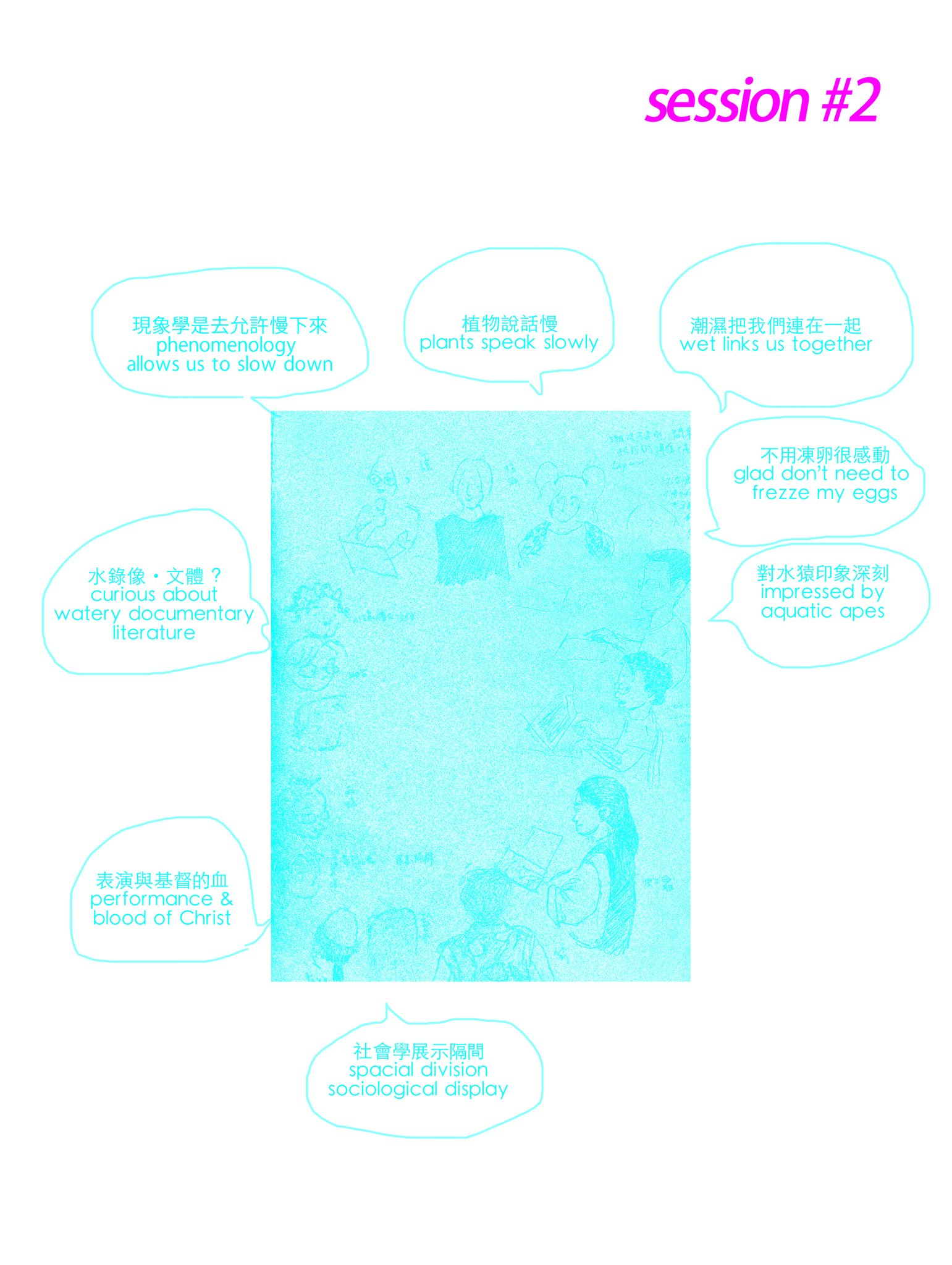
Exhibitions, often the most productive and driving forces in the art world, tend to have their processes and outcomes predetermined long before they happen. However, the Bodies of Water reading group experiences led Hsu to believe that reading groups could be an ideal way to engage participants in ideas about exhibitions (whether related to themes or works) during the extra time afforded by delays. This inspired a series of reading groups under the theme The Color of Dinosaurs is Love for China. These sessions included texts such as Karen Barad’s What Is the Measure of Nothingness? Infinity, Virtuality, Justice, Astrida Neimanis' Bodies of Water, and Anna Tsing’s articles familiar to Taiwanese audiences, such as The Mushroom at the End of the World. They also featured discussions on Donna Haraway’s The Teddy Bear Patriarchy, screenings of works-in-progress by filmmaker Zhong Jialing, talks, and even coloring activities. “Not only can curators learn from reading groups, but I also hope that these gatherings attract audiences curious about the knowledge conveyed through these texts, giving them an opportunity to engage deeply and discuss together,” Hsu explained.
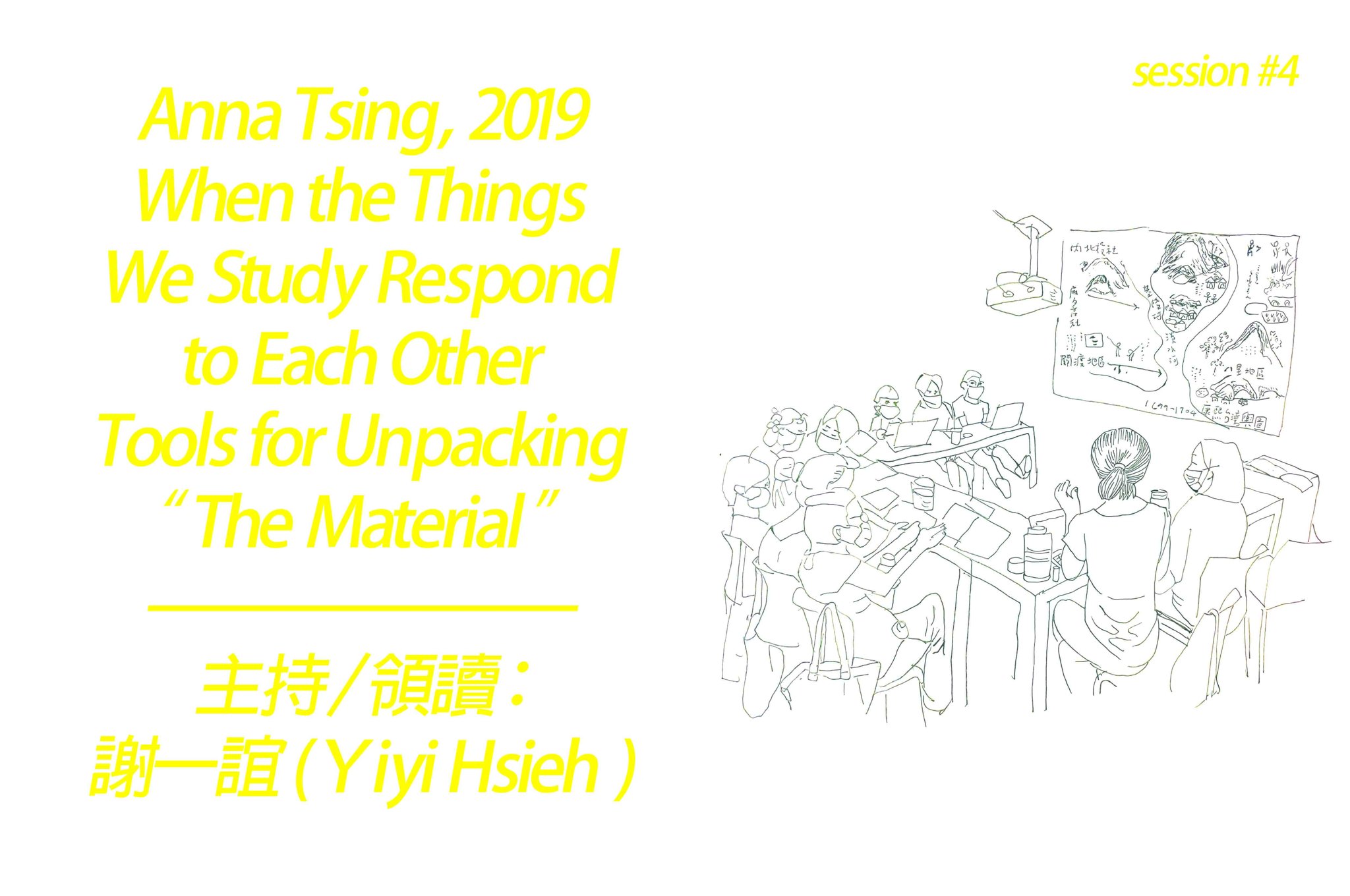
After a series of reading groups, the exhibition’s theme converged on the concept of “care,” resulting in a zine that included visual documentation by Wu Rengyu and written excerpts from other participants. This culminated in the exhibition Living Together, which showcased the possibility of nurturing, transforming, and even subverting the interplay between autonomy and purpose, the inevitable and the accidental. As for the knowledge produced by the reading groups, Hsu remains open-minded: “I must admit that the entry barrier for reading groups is relatively high. Whether the discussions translate into wisdom in everyday life depends on what truly resonates with each participant. I believe that those who attended the reading groups will have a very different experience when they see Living Together.”
Reflecting on that time, the boundaries between knowledge and emotion blurred as I navigated between two reading groups—one consisting of a few familiar friends engaging in informal online discussions with occasional readings and concept exchanges, and the other being a more structured, public-facing event that carried the weight of knowledge. Small interactions attempted to bridge the gap between unfamiliar participants, nourishing the ever-changing relationship between myself and the environment. After we each produced an exhibition, Wu Rengyu took on a new role as a caregiver and formed the duo “Lám-Nuā” with Hsu Shih-Yu. Together, they contributed research, translation, and workshop material for my initiative Citing Bar. Since then, it feels as though the landscape has subtly shifted, or perhaps it hasn’t. We continue to roam nomadically—individually, and occasionally, together.
Transversal feminism
In their evaluation of the effectiveness of reading groups, Astrida and her collaborators used traditional qualitative data analysis, inviting participants to share their experiences. Through their feedback, the following benefits were identified in teaching, research, artistic or activist practices, and daily activities: 1. The production of new knowledge and its dissemination; 2. The building of fieldwork and community; 3. Resistance to neoliberalism; 4. Negotiating moral complexities.
However, they did not stop at these affirming and positive assessments. Instead, they went further by proposing the method of transversal poetics, which explores more obscure and challenging areas. The concept of the transversal, as originally proposed by scholar Nira Yuval Davis—who focused on issues of migrant belonging—served as an alternative to assimilation politics. Later, Rosi Braidotti developed the idea of transversal posthumanities, using a new materialist framework to identify how posthuman knowledge production can resist cognitive capitalism, steering towards community-driven, non-profit-oriented minority knowledge.
Their application of the transversal involves drawing an arbitrary line across the feedback text from participants, then stringing together the words the line crosses into a short poem. This method "brings seemingly unrelated things together, creating new connections." Although the line is drawn arbitrarily, it helps transcend the known, illuminating marginal or difficult tensions that might otherwise go unrecognized or unnamed. For example, as Astrida’s line passed through a large blank space at the end, it revealed something she hadn’t always been willing to admit: most of her companions were white.
At the end of the essay, I borrow from Vanessa Machado de Oliveira’s book Hospicing Modernity: Facing Humanity's Wrongs and the Implications for Social Activism, where she introduces the concept of the 4 H’s, which encourage practicing humility, honesty, humor, and hyper-self-reflexivity—concepts that I find particularly challenging to confront.
As we wander through the wilderness or marketplace of knowledge, we can always find comfort in those we meet along the way. Those we don’t meet, however, continue to cross paths with us in various forms, helping us shed the arrogance, self-deception, overattachment, and irresponsibility that numb our senses and obscure our vision. Instead of asking what the knowledge we’ve acquired is for or how it contributes to society, we might need to let go of the idea that knowledge must always be transmitted or shared in ways we imagine. After all, such contributions may be useless to others. Rather than questioning whether the process can come to fruition without an end result, perhaps we should ask: in this cycle of self-exploitation and collaboration for mutual gain, have we experienced true joy? And what corners remain in the shadows, unseen?
When we are able to sense these countless intersections, such different individual lives can illuminate one another, reminding us that without the words and stories others leave behind, we could not write poetry alone.