Uncomfortable Zones of Knowledge and Relationships, and Translucent Possibilities — Explorations and Practices of the munus Reading Groups
Authorciting-bar-editor
Published
Written by Hung-Fei WU
In spring 2024, when the third-floor mezzanine at Solid Art was taken back, Citing Bar, the initiative I founded, brought its run of exhibitions to a close and turned to publishing, international exchange and workshops. Continuing slowly, I knew that this exploration and learning had only just begun. Citing Bar’s projects, responding to concepts such as rest, healing, disability and climate justice, reflect the intertwined systemic problems of modernity, which render any single narrative or solution clearly ineffective. Through researching, translating, writing, discussing and playing, an interest in the collective production and transmission of knowledge gradually took root, and so I invited collaborators who had taken part in Citing Bar to join the next stage of the project: exploring the possibilities and impossibilities of “collective healing.”
The experimental intention behind this was to build a long-term community with agency, rather than an “execution team” driven by outcomes and bound to a linear project timeline. The theme carried strong social ambitions: “In a world riven by division and trauma from war, conflict, oppression and disaster, what wisdom about healing can we learn by ‘being together’?” From there it leads to the big question of what art is for. Rather than chasing the production of new knowledge, then, we used the exploration of collective healing to return to the feminist environmental humanities spirit of care and justice that Citing Bar holds dear, and to Rosi Braidotti’s call for “non-profit-oriented alternative knowledge,” trying to embody the possibility of a “unity of knowledge and action.”
So began a year-long, entirely new experiment of collective research accompanied by social fieldwork, moving back and forth between the thoughts and feelings stirred by reading texts and by lived relationships. Now, at what seems to be the end of another stage, this essay takes stock of the rich harvest and inspirations of the past year, and of the directions in which we might continue.
munus: A Contemporary Healing Research and Reading Community
With the reading group as a collective method and contemporary healing as its theme, four members or groups—Lám-Nuā, Ting-Ting Cheng, LI Weiwei and Yu-Lun Hsu—and I each proposed questions to explore or texts to read over the year, and each formed a group and set how often and in what way it would meet. Members could also move between groups and join freely. The interim outcomes of the research were required to be public and shareable, in any form.
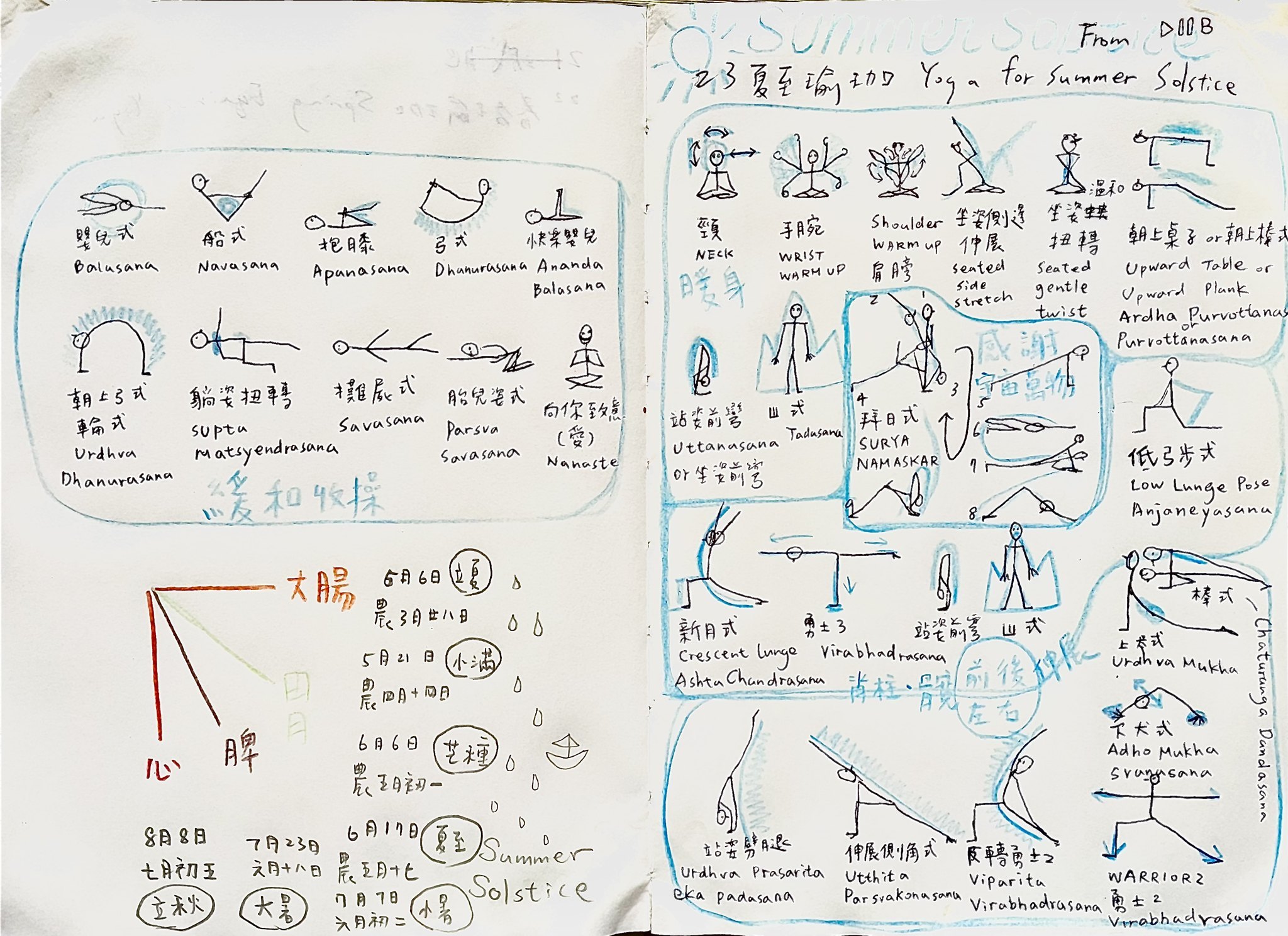
Lám-Nuā was Citing Bar’s closest collaborator in 2023, and both of its members entered important new stages last year: HSU Shih-Yu became a mother, and Wu Rengyu began working as a care worker while training for certifications in fascia work and yoga. “Water Infrastructure: Fascia as a Metaphor for the Hub of Ecology and Infrastructure” gave the pair’s recent translation and discussion of scholarly writing on bodies of water and posthuman feminism a more concrete form: in Wu’s workplace as a care worker, in the after-work yoga classes Wu started as a community activity, and in a small summer-solstice trip of river tracing, camping and cooking in the mountains.
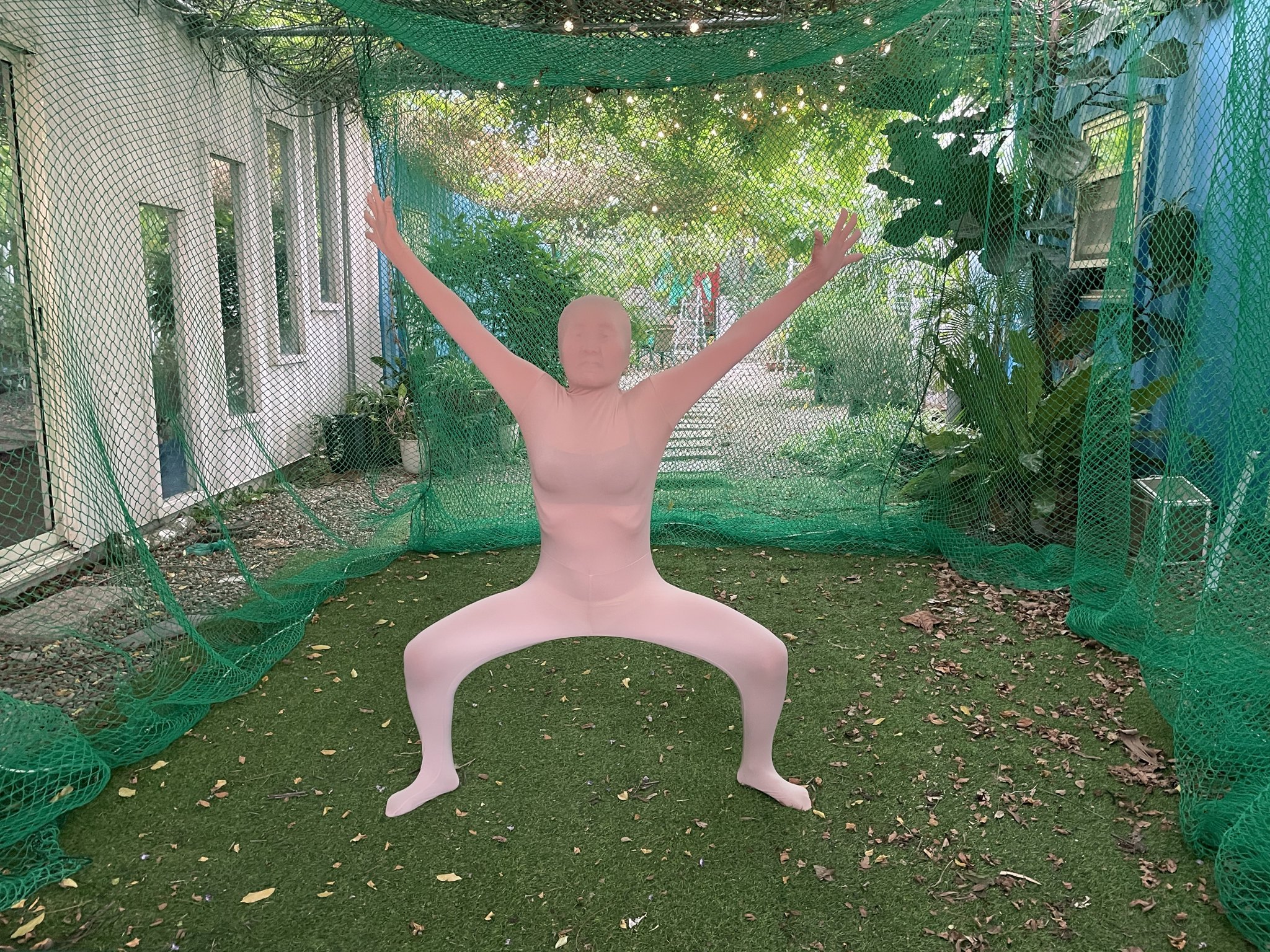
Lám-Nuā, “Water Infrastructure: Fascia as a Metaphor for the Hub of Ecology and Infrastructure.” Members: Wu Rengyu, HSU Shih-Yu, LI Weiwei, WU Hung-Fei and members of the yoga class. For the proposal, Wu Rengyu wanted to try a different, playful form of presentation, inspired by a clip that Laura played during The FEELed Lab’s “listening and attuning” summer school, which Wu attended with the author: Subwoolfer’s “Give That Wolf a Banana” at the Eurovision Song Contest, in which masked figures in yellow bodysuits and suits dance.
Summer-solstice yoga poses led by Wu Rengyu (Drawing: Wu Rengyu)
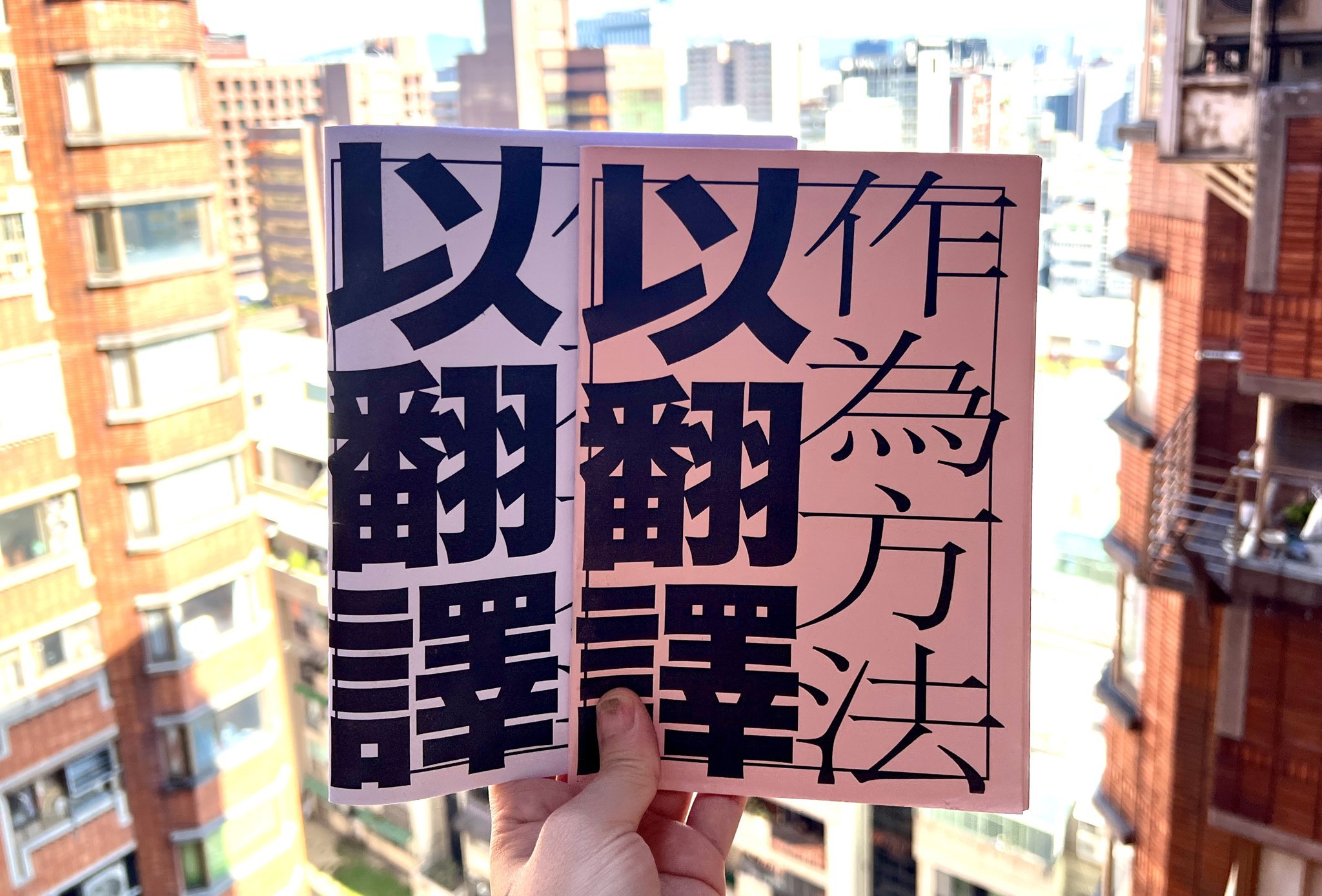
Ting-Ting Cheng was the only artist in the reading community. Cheng’s project Zoë, part of Citing Bar’s third season, continues the artist’s long-term research into migration, mental health and speech acts. The group Cheng convened this time, “Translation as Method,” started from the texts of 《日常運動》, taking the translation of its writing as a form of self-healing to discuss how the method might spread collectively. All participants were arts workers with translation experience, and each proposed an article they wanted to translate on “social movements / social conditions” and “mental health / healing.” The translations were published as a zine and presented and discussed at the exhibition munus I: Himali Singh Soin: Static Range in May this year.
Ting-Ting Cheng, “Translation as Method.” Members: Ting-Ting Cheng, HSU Shih-Yu, LI Weiwei, WU Hung-Fei, Tsai Meng-Hsuan
Art critic LI Weiwei, editor of Citing Bar’s publication Potable Paper, was the member most closely involved in the shared discussions and dialogues of munus. Li proposed an interdisciplinary reading group on The Spirit Catches You and You Fall Down, which follows the clash between a Hmong immigrant family in the United States and a radically different medical system, belief system and set of social institutions, to ask: “How does a mainstream medical system driven by a desire for control, analysis and conquest shape the way we understand suffering? Which beliefs about the body, illness and healing have been overlooked? What imaginaries that can make room for alternative forms of healing might be rebuilt?” Li brought together therapists, pastors, activists and people from the food industry from Taiwan, Hong Kong and Malaysia—the group spanning the widest range of fields—and organized visits, gatherings and a family constellation workshop.
Curator Yu-Lun Hsu had taken part in several Citing Bar events, has researched collectives, and is an old comrade of mine from Bamboo Curtain Studio and a fellow member of our survival mutual-aid group. Inspired by the form of writing in the Citing Bar reader A Decolonial Feminist Epistemology of the Bed, and by a loved one’s illness and a personal tug-of-war with fear, Hsu proposed “Border Crossers and Others: On Disability, Pain, Injury and the Possibility of (Not) Healing,” an attempt to build a creative reading group that explores poetry as a way of leaping across time and space. At online poetry readings held roughly every six weeks, members chose and led poems according to the state of their own lives; alongside texts from different countries and poetic forms they also shared their own writing, gradually forming an intimate bond of companionship and support at a distance.
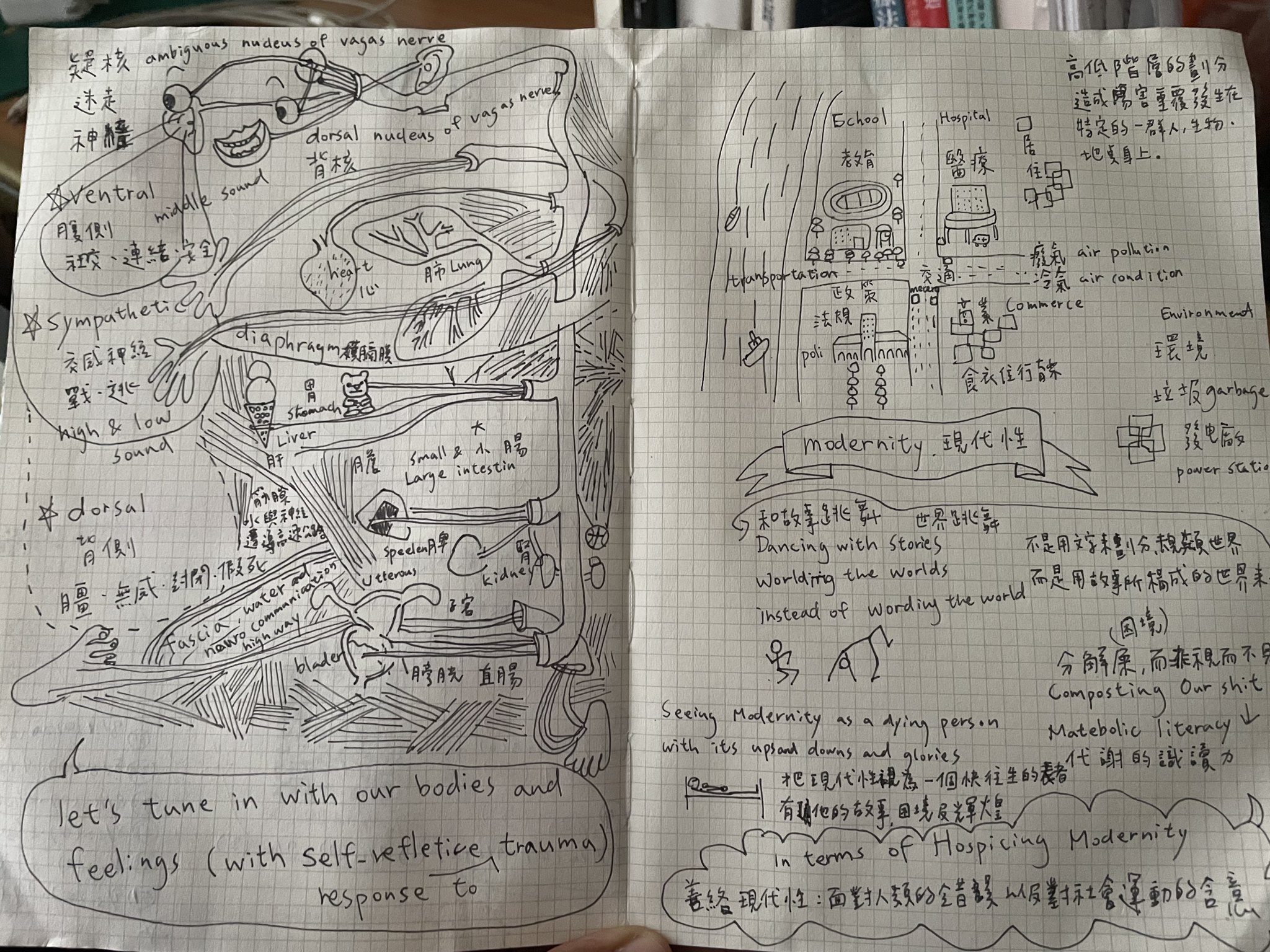
The book I chose, Hospicing Modernity: Facing Humanity’s Wrongs and the Implications for Social Activism, was recommended by my curator friend Lucia Pietroiusti and laid an important foundation for my subsequent curatorial projects. Its core challenge: in the face of difficulty, despair and the end of the world, how can we take responsibility and let go of our dependence on modernity, facing together the end of the world as we know it, so as to heal collectively? Wu Rengyu and LI Weiwei joined this reading group; our discussions took place sometimes online, sometimes woven into one another’s activities, and sometimes by the river alongside easy conversation. The time spent reading alone also became, amid frequent gatherings, a way for me to settle and rest by returning to my own independent research.
Reading notes on Hospicing Modernity: Facing Humanity’s Wrongs and the Implications for Social Activism (Drawing: Wu Rengyu)
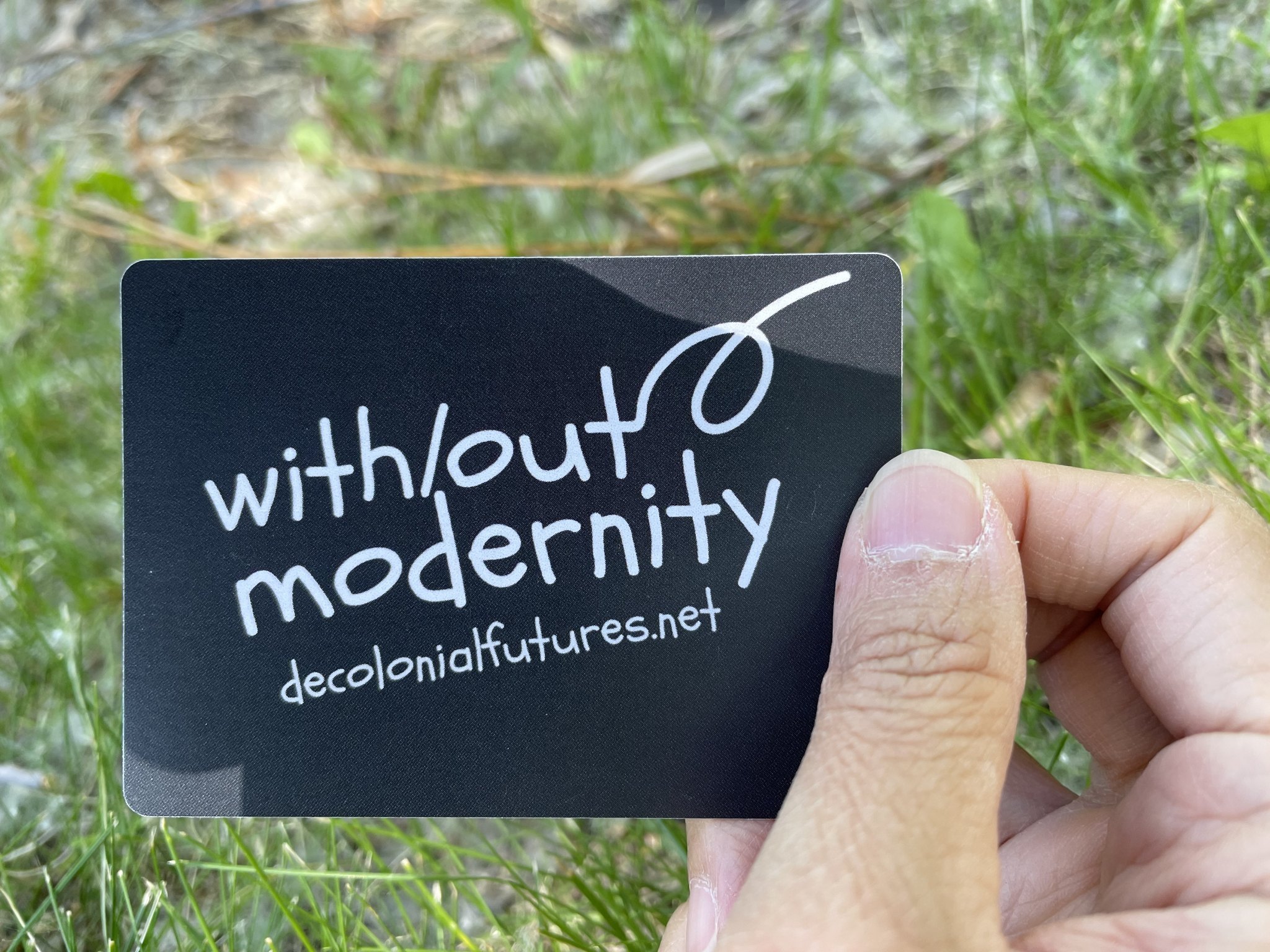
Wu Rengyu took part twice in The FEELed Lab’s summer school; the “with/out modernity cards” drawn there were designed by Gesturing Towards Decolonial Futures, the collective of which Vanessa Machado de Oliveira, author of Hospicing Modernity, is a member. (Photo: Wu Rengyu)
Fluid Relationships and Minor Knowledge
Maybe we can share the work—when I am exhausted, you take over for me, and so on and so on; we share the labour and multiply the love. In this way, we begin to unsettle the architecture of the clearly visible.
—Himali Singh Soin, Translucent Manifesto
Over nearly a year, munus worked on two tracks, independent and collective: besides reading and discussing books and texts on contemporary healing, we also investigated “the collective” and “collective methods” themselves. Along the way I considered inviting the reading group members to co-curate an exhibition, even to form an art collective in the end. Looking back on this unrealized goal, I found that the reasons lay in the group’s initial make-up: each member was highly distinct in identity, concerns and research methods, and kept their autonomy. One companion, for example, pointed out that framing this fluid learning process with an exhibition as its outcome would inevitably affect its creativity and rob the reading group of its meaning as an “escape hatch” from everyday mechanisms of production. So in sustaining this learning community we preferred to keep it free and fluid, letting the members of the small groups be more like dispersed individuals than a tightly knit entity.
The alternative knowledge and flashes of insight sparked by the reading groups circulated among the members, occasionally trickling outward through zines, workshops and other activities that invited participants to talk and exchange freely. How should we regard this non-authoritative, feminine knowledge that sits between the intimate and the public? And how can minor, non-profit-oriented knowledge, which depends on a community’s own momentum, keep going?
A community’s momentum waxes and wanes between plans and the unpredictable. Within a framework of just one year and a theme of contemporary healing, the blurriness and uncertainty brought by too much openness and too many possibilities demanded far more time and energy in communication than independently researching a defined subtopic would have, and left me and my companions exhausted and uneasy. What I have learned is that one should set out outcome guidelines that are as concrete as possible from the start, while allowing the paths to stay full of possibilities; and that, switching between independent and collective modes, I should manage my time better—dropping anchor while drifting, so as not to lose my way.
At almost the same time, social fieldwork outside the art world opened a new path of learning for me. The recent expansion of the Legislative Yuan’s powers sparked a large-scale recall movement in civil society. I was fortunate to take part, meeting and working with volunteers from all walks of life brought together by shared values, listening closely to different voices and coming to understand their diversity and complexity. This precious experience not only widened the familiar but limited echo chamber of the arts community; it also concretely embodied what this year’s healing community had read and learned, the two reflecting and inspiring each other toward a “unity of knowledge and action.”
munus: A Slow Artistic Social Action
It is time to share where the project’s name comes from. munus is an ancient Latin word meaning both gift and tax, both receiving and giving—a dynamic relationship of exchange between people. What particularly interests me is that it is the common root of community and immunity, symbolizing the effort a group must make to live safely and healthily. It also brings to mind the precious lessons I have learned over the past two-plus years from facing the uncomfortable zones of knowledge and relationships.
The two exhibitions, munus I: Himali Singh Soin: Static Range and munus II: Immunity and Community for Contemporary Healing, happen to correspond to the two axes I have explored in recent years, ecofeminism and society. Though they seem very different in their points of departure and formats, both belong to a years-long inquiry into what art can do, and both point to directions for continued effort: first, how can art help us imagine the possibility of healing together—and before that, how do we face the sickness and unease of our collective culture? Second, how can art respond to a society so full of division and conflict—is solidarity possible?
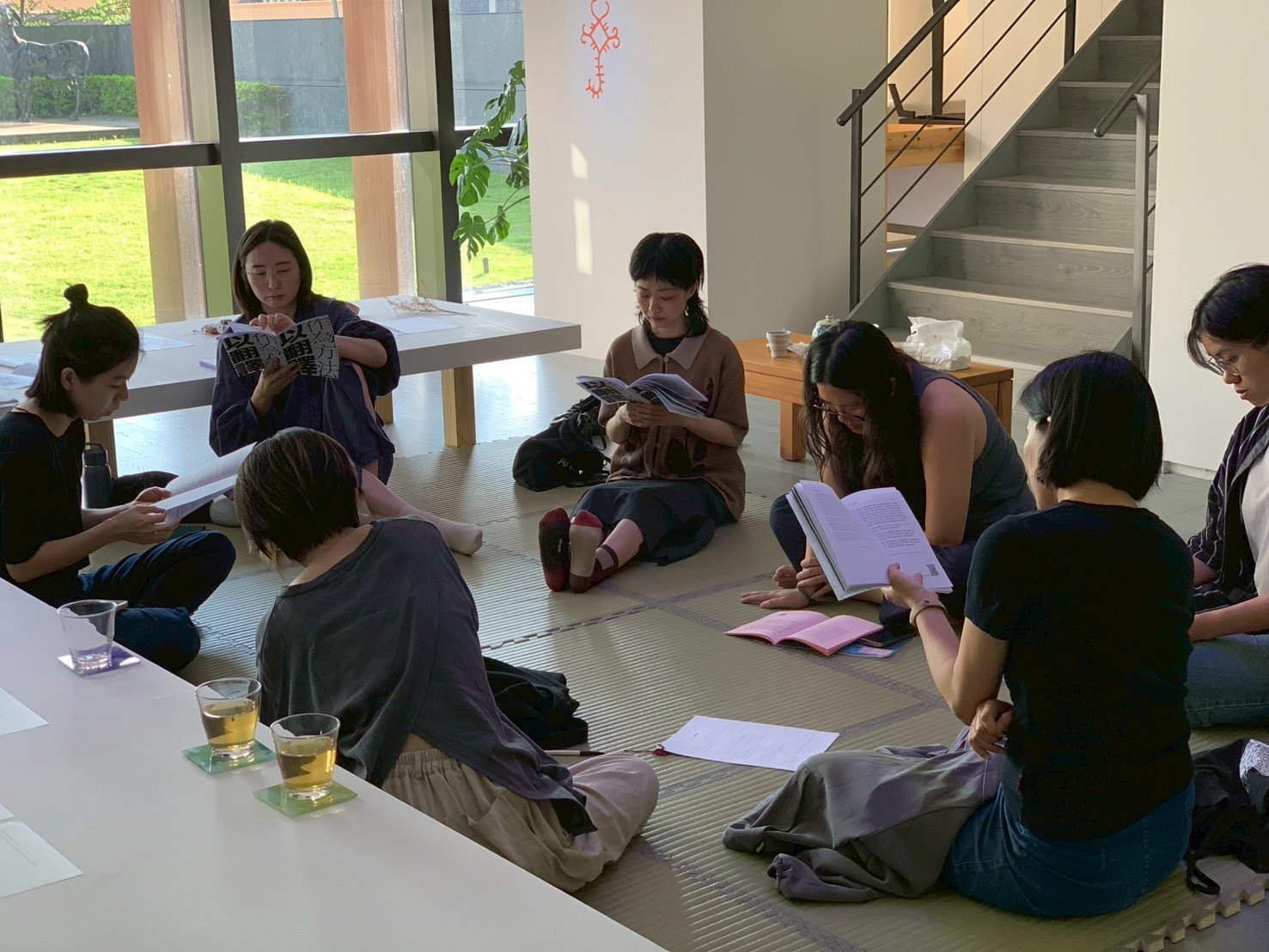
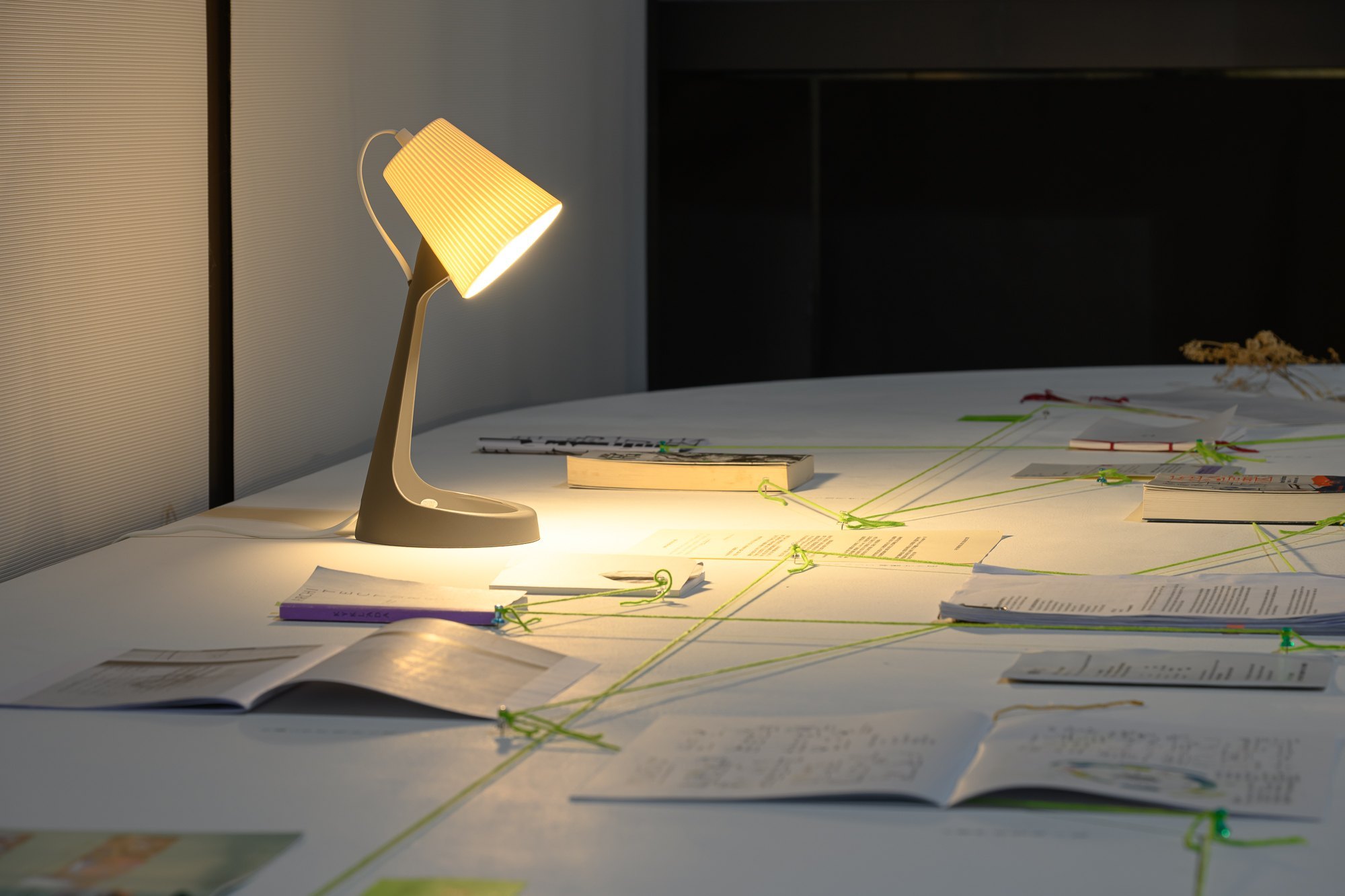
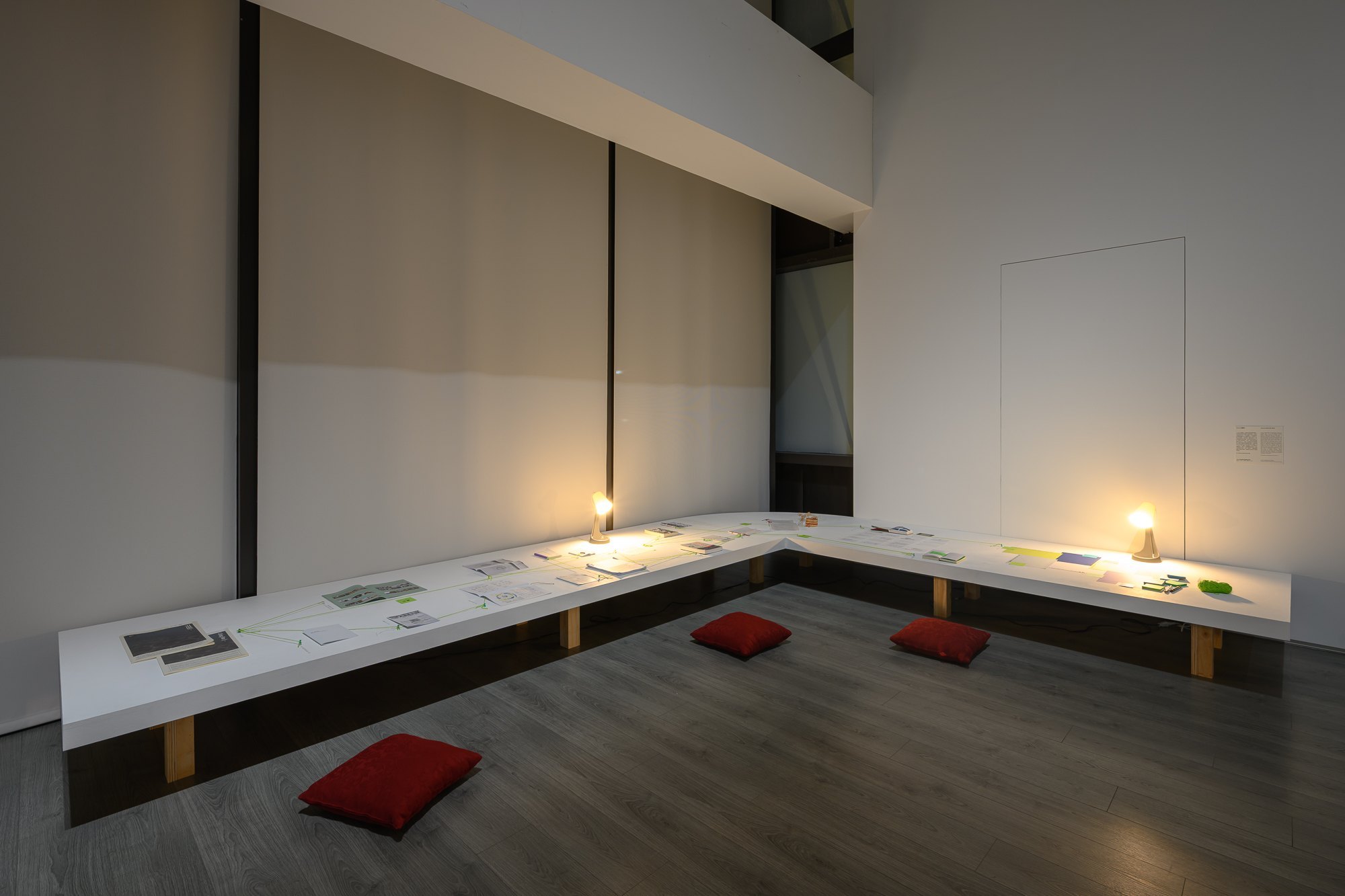
The reading groups presented as the “munus editorial team” at the exhibition munus II: Immunity and Community for Contemporary Healing. Planned by HSU Shih-Yu. (Photo: ANPIS FOTO Wang Shih-Pang)