
Written by Hung-Fei WU
In her 2023 essay “Information Overload,” which stirred much debate in the art world, Claire Bishop traces in depth the evolution of the increasingly common “research-based art” and its entanglement with the development of digital technology and with the construction and transmission of history and knowledge. At the end of the essay, Bishop cites Anna Boghiguian’s 2015 work The Salt Traders as an example of research successfully internalized and embodied without trading away aesthetics or the artist’s own sensibility. This reminded me of the method of “citation” I have been exploring over the past two years. When so-called research-based art seeks to stand alongside feminist and postcolonial theory in decentering knowledge and resisting its authority and domination, a feminist politics of citation does more than keep a work or an exhibition from collapsing into an overload of information or archival re-presentation, or embody one’s relationship to and inspiration from one’s sources: it is also about ethics and resistance, and, more actively, about connection and solidarity.
Power, Resistance and Knowledge Production
In Living a Feminist Life (2017), Sara Ahmed reminds us of the value choices and power relations reflected in citation: we should pay attention to the habitual structures and systemic injustices behind how knowledge is built and disseminated. For Ahmed, citation is “how we acknowledge our debt to those who came before; those who helped us find our way when the way was obscured.” Responding to Tides in the Body, an exhibition I curated, the critic Hsu Chu-Chun offered a profound reading of the “politics of citation”: citation thus becomes not only a brick in the fortifications of feminism; this “bad list” also becomes an important index, each citation carrying its own differences, ready at any moment to break apart the historical narratives that would absorb it. This is, if anything, an act of resistance charged with political meaning.
From the perspective of my own research and practice, this means attending to and learning from “alternative knowledge”—wisdom that has never been written down, heard or passed on in mainstream society, yet has survived a long history of oppression. Perhaps it is precisely what can help us understand the complex reality of the planetary catastrophes now striking all life, and find shelter within it, supporting one another to survive. How do we unearth and cite this wisdom without turning it into another form of exploitation? How do we find the right language to connect with one another rather than building yet another wall of knowledge? These are the self-doubts that producers in a closed, linear art ecosystem (whether they produce works or exhibitions) so often have to face.
The racial and gender blind spots of academic citation were raised as early as 1991 by the feminist scholar Katie King in her essay “Bibliography and a Feminist Apparatus of Literary Production.” She describes a workshop designed by Lenore Hoffman in the late 1970s, in which students initiated collective local research on women’s literature, including going door to door to find the women in the area who wrote poetry but were absent from the written record. This “bad list” decentered the academic institution and empowered the participating students through alternative research methods. King further points out that every researcher is a political medium: telling the story of how stories are produced requires feminists to be implicated in it, rather than to remain in a neutral position of observation and analysis. How is this epistemological paradigm shift practiced in research within contemporary art? And when artists become researchers, how do they weigh the value of their sources—and when their research is turned into artistic production, what new “knowledge” is produced through this so-called political medium?
Unfolding Connections from Genealogies: The Body as Citation
In Bodies of Water, Astrida Neimanis supports Ahmed’s acknowledgment of debt in the politics of citation and goes further, proposing a “watery” politics of citation that gives it a more active meaning of connection and sustenance. A watery politics of citation means unearthing the connective qualities that already exist in bodies and matter—every body is a unique citation. What our bodies repeatedly write, and what waters them, are the genes of our parents and ancestors as well as the environmental matter that flows through us—both metaphor and simile. For Neimanis, tracing such genealogies is, on the one hand, a feminist politics of citation: acknowledging theoretical debts as an ethical practice; on the other, it encourages thinking about difference and subjectivity—a central question of contemporary feminist thought that can be developed productively when the materiality of bodies, with their various porosities, flows, stoppages and numerical complexities, is taken into account.
Watery citation, as Neimanis describes it, is about keeping marginalized genealogies of thought alive and continuing, and about letting particular bodies go on flourishing, as bodies of water do. I have tried to bring these beautiful possibilities to my understanding of research-based art, in an attempt to break through current research models focused on information, archives and text. If what we unearth and invest our research in is our own origins and debts—if taking in is at once reaching out—how might the art that results look different, and how might the encounter between work and viewer become more dimensional and alive?
Jes Fan, for example, fills abstract, curving glass sculptures of the body with the artist’s mother’s urine, hormones that stimulate lactation, melanin and even octopus ink. These “waters,” which ought to flow, seem trapped or congealed in the finished sculptures. At first glance the works look like the dust settling after the artist’s transformations through cultural diaspora and gender transition, yet their transparency and fragility reveal an isolated, alienated body longing to break through—a wish to flow with society, at ease.
And how can difference become a starting point for connection? In a 2009 performance by the American artist Caitlin Berrigan, two performers pass a bottle of cow’s milk (or perhaps human milk?) between them, mouthful by mouthful, until one bottle is full and the other empty, and then pass it back the other way. When the milk that we take in one-directionally from the living world to nourish our bodies must instead be shared and borne together with a community of fate—fully received, then fully given away—the work, in the most minimal language, unsettles our assumptions about the boundaries of the body and about gifts and debts.
Berrigan’s 2007 performance Life Cycle of a Common Weed turns the closed discipline of infectious disease into an interspecies connection between human and plant. Because the artist has hepatitis C and must avoid blood contact with others—and because dandelion is a well-known remedy for the liver, while the nitrogen in human blood is an important nutrient for plants—the artist’s virus-carrying blood was drawn to water dandelions, nourishing the plant in return for the healing it offers. Berrigan went on to invite participants to have their own blood drawn to feed the dandelions, taking home a pot of dandelion seedlings and drinkable dandelion tea.
Patty Chang, an artist long concerned with gender politics, care and the environment, has been developing Milk Debt since 2018—perhaps one of the works that most profoundly realizes Neimanis’s watery politics of citation. The work grew out of the artist’s near-crushing worries about politics, climate change and family. Having found brief relief in writing them down, the artist widened the collection from colleagues and friends to an open call, and handed the gathered anxieties to performers who read them aloud while expressing breast milk, bare-breasted, facing the camera.
The title Milk Debt comes from Buddhist thought on breast milk: every child owes their mother the milk that nursed them. Yet I believe the meaning of this work reaches far beyond the genealogy of blood relations—especially once one learns that lactation releases oxytocin, a hormone that can stir love, comfort and connection. These anxieties, written in many languages, whatever their scale, common and familiar or strange and fantastical, are proudly named and read aloud as the mothers’ milk flows, creating a powerful space in which those willing to share their vulnerability can stand together.
Citation as the Possibility (or Impossibility) of Community
In the circulation of milk, urine, blood, viruses and hormones across boundaries, so many isolated, singular “I”s flow together into a “we”—a community of fate formed at a certain moment, in a certain place. What possible futures might this bring about?
Canadian curator Maiko Tanaka’s essay “Feminist Approaches to Citation” has inspired me deeply, intellectually and emotionally, and where the two intertwine. It describes FAGing it Forward, a 2013 project by the Feminist Art Gallery (FAG) that launched a participatory platform for citation: the project space displayed more than 250 name tags, each bearing two names—the participant’s and that of a woman they wished to acknowledge. For Tanaka, beyond making visible a feminine genealogy of inspiration and support, the project shows the many ways in which communities of women artists come into being and flourish: citation is not only an acknowledgment of the sources of inspiration but a way of building those cited into a community, performing it into existence. And, in contrast to an art world that values prominence, exceptionalism and charisma, the FAG project commits to an ethical practice of exchange by citing marginalized forms of sharing, labour and support. The names on the walls and the ongoing conversations in the space are woven together on the political and ethical ground of women’s forms of relationship and support—a practice that is not merely a utopian exercise but an affirmation of values beyond the domination and division of production in an art world that has yet to break with the logic of capitalism. The FAG project, she writes, embodies how citation can be a methodology for “living.”
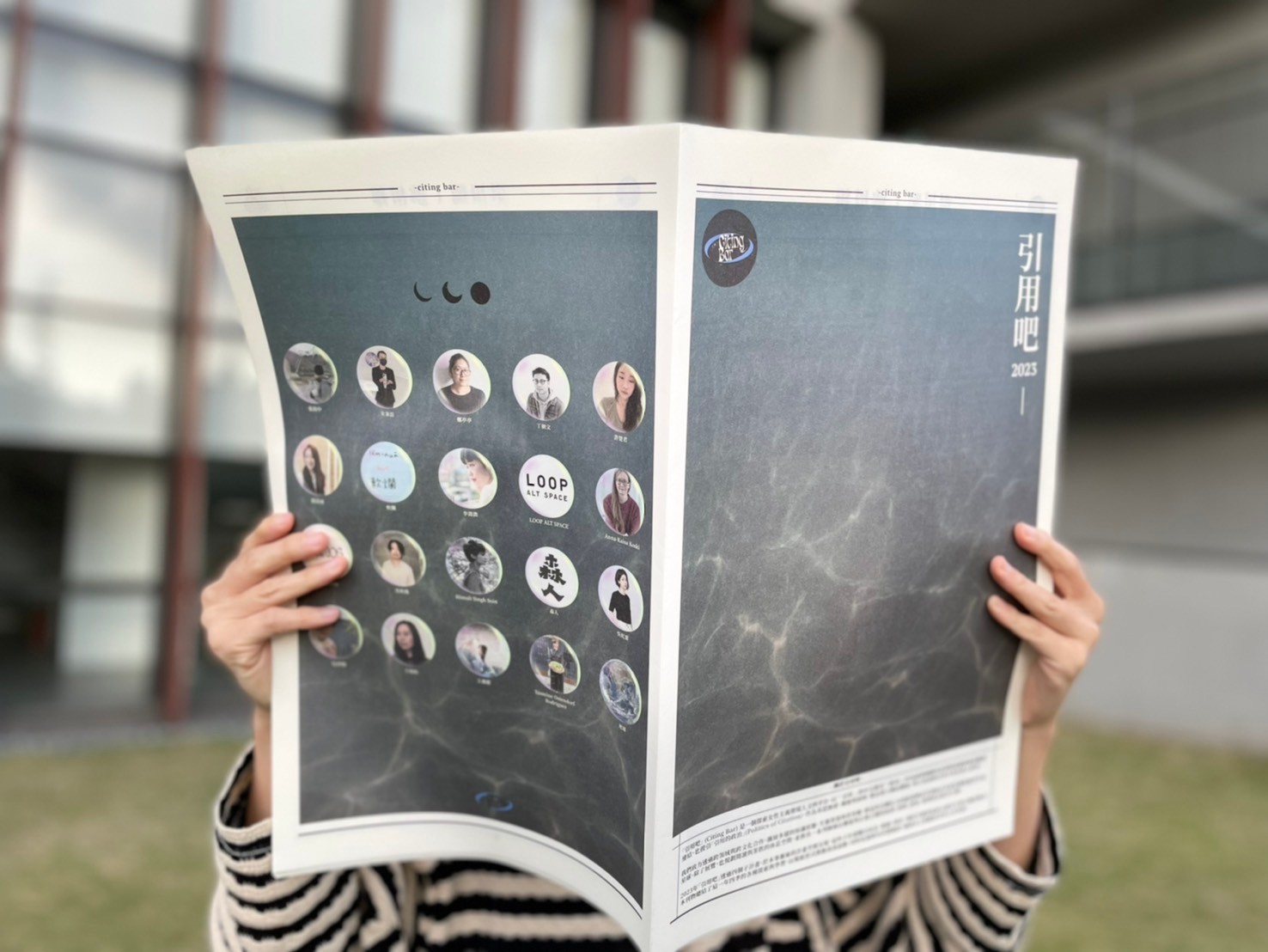
Among all these questions and possibilities, perhaps what I have been exploring with Citing Bar, which I founded in 2023—discussing, writing, making and organizing events with a group of companions—is how to live well. Last autumn, the artist Ting-Ting Cheng brought the project Zoë, made during a residency in Paris: taking Qiu Miaojin’s Last Words from Montmartre as its text, Cheng invited nine local migrant women to perform readings from the book, and also interviewed the performers about their lives as migrants, gathering these into a booklet titled Zoë. Yet citation is far from an ending. During the exhibition at Solid Art, Cheng presented two performances that adapted Zoë into a script read by nine migrant women living in Taiwan, recruited through an open call; at the same time, the life experiences of these migrant women in Taiwan were also interviewed and recorded, to be cited onward at certain moments, now and in the future.
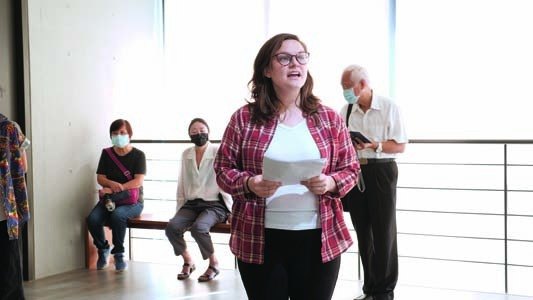

When an artist yields the stage to the bodies of those being cited, the stage becomes a carrier bag, holding all kinds of life stories to be carried to more places and shared with more people. Even across different times and places—Qiu Miaojin, the migrants in Paris, the migrants in Taiwan, and countless more people without faces or names—all come into being in the moment of citation: each of us is Zoë.

After the second live reading of Zoë, Cheng gathered around a table with the performers and the audience, eagerly exchanging reflections and responses to the project and stories of life in Taiwan and away from home. I could sense that over several rehearsals these migrant friends had developed a kind of bond, and I wondered whether, “outside” and “after” becoming art, it might grow into a real community—a bond of genuine reliance and trust, one that can grow and last.
Of course, in an ever more unpredictable future, the wisdom and warmth of this moment may not stay with us all the way. But as Maiko Tanaka puts it, there are particular moments in our lives when the wisdom in these shared words sustains each of us, and together they form a source of interwoven wisdom and support that allows us to move toward the future. When the small resonances born of colliding hope, trauma, love and loneliness slowly gather into a strong echo beneath the roar of discrimination, oppression and war around the world, every resistance, connection and healing becomes possible. And so I am willing to believe that this would be truly abundant art—art that can be moving at the same time.